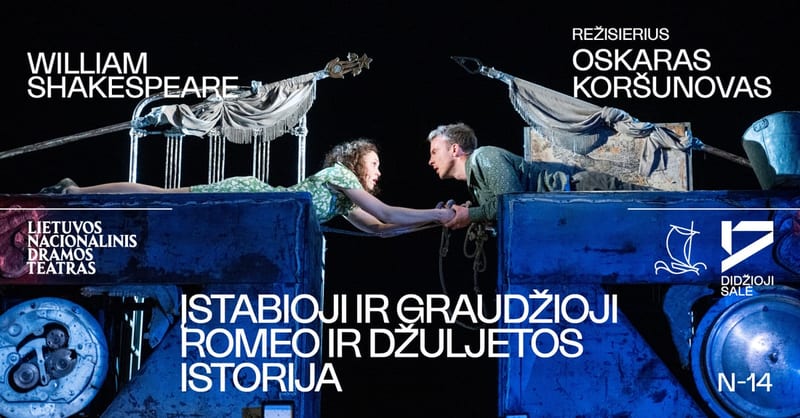
On October 18, the performance THE WONDERFUL AND SAD STORY OF ROMEO AND JULIET will be subtitled in English. Subtitles are best viewed from row 17.
◊ 2003 Golden Stage Cross. Best Director – Oskaras Koršunovas
◊ 2003 Golden Stage Cross. Best Scenographer – Jūratė Paulėkaitė
Director — Oskaras KORŠUNOVAS
Scenographer — Jūratė PAULĖKAITĖ
Composer — Antanas JASENKA
Costume Designer — Jolanta RIMKUTĖ
Lighting Designer — Eugenijus SABALIAUSKAS
Choreographer — Vesta Rasa GRABŠTAITĖ
Assistant Director — Augustas GORNATKEVIČIUS
CAST:
Juliet Capulet – Digna KULIONYTĖ, Agnieszka RAVDO
Romeo Montague – Laurynas JURGELIS
Mercutio – Marius Michailas REPŠYS
Tybalt – Kęstutis CICĖNAS, Saulius AMBROZAITIS
Benvolio – Eimantas PAKALKA
Juliet's Nurse – Eglė MIKULIONYTĖ
Friar Laurence – Arvydas DAPŠYS
Paris, a kinsman of the Prince – Gediminas RIMEIKA
Capulet – Dalia MICHELEVIČIŪTĖ
Capulet – Vaidotas MARTINAITIS
Montague – Vesta GRABŠTAITĖ
Montague – Remigijus BILINSKAS
Prince Escalus; Apothecary – Arūnas SAKALAUSKAS
Peter, a servant – Aurelijus POCIUS
Townspeople: Gailė BUTVILAITĖ, Gerda ČIURAITĖ, Taura KVIETINSKAITĖ, Lukas MALINAUSKAS, Kamilė PETRUŠKEVIČIŪTĖ, Augustė POCIŪTĖ, Oskar WYGANOWSKI, Arūnas VOZBUTAS
Premiere – June 13, 2003.
Premiere of the revived performance at the Lithuanian National Drama Theatre – February 6, 2015.
Director Oskaras Koršunovas:
Shakespeare’s play “Romeo and Juliet” is most often imagined as an ode to romantic love. In reality, it is a social drama in which simple love takes on the highest resonance of tragedy under dramatic circumstances. In this tragedy, what interests me most is that love is born and unfolds in hatred, in the atmosphere of war in Verona. I wanted to emphasize this paradox: hatred kills, but it is precisely what ignites the spark of love.
One can also speak about this on a divine level – love is born from hatred in order to defeat it. It may be that hatred itself is actually born from nothing. The example of the Montagues and Capulets is eloquent precisely because no one knows the cause of the discord anymore. Everyone has long forgotten the cause of their war. Young Tybalt accepts hatred and defends it as a tradition. We often nurture such traditions that create opposition from perceived differences and sustain hatred. This is, unfortunately, an increasingly applied principle – to unite society by searching for enemies.
While staging the play, I wanted to delve into how hatred shapes differences and becomes the cause of everything. It seems to me that hatred is the foundation of differences, which establishes an illusion of difference between the Montagues and Capulets, deceives them, and sets them even more against each other. This is how all societies have divided themselves.
Love eliminates differences. It is the only thing that shows that, in essence, there is no conflict between the clans. Love creates freedom, and in freedom, there are no opposites. Unfortunately, Romeo and Juliet only find freedom in death. Sacrificed freedom destroys not only the modernity determined by the children but also the tradition so cherished by the parents.
Producer of the performance – OKT / Vilnius City Theatre
Co-producers – Avignon Festival, Remscheid City Theatre, Ministry of Culture of the Republic of Lithuania, THEOREM Programme