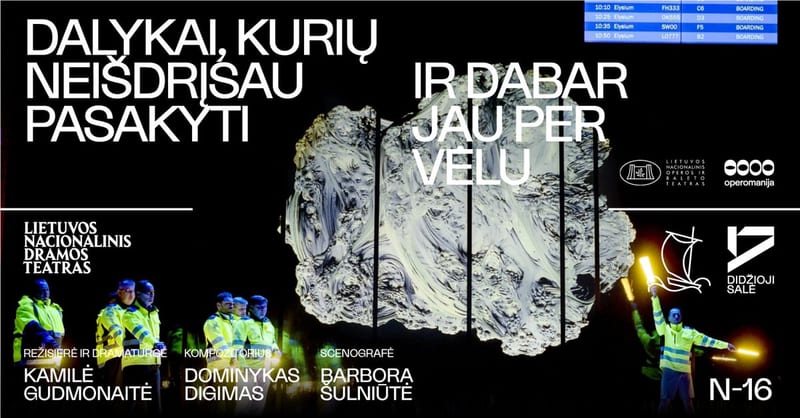
The November 28 performance of THINGS I DARED NOT SAY, AND NOW IT IS TOO LATE will be subtitled in English. Subtitles are best viewed from rows 10-15.
Director and playwright — Kamilė GUDMONAITĖ
Composer — Dominykas DIGIMAS
Set designer and video projection concept author — Barbora ŠULNIŪTĖ
Choreographer — Mantas STABAČINSKAS
Costume designer — Juozas VALENTA
Lighting designer — Julius KURŠYS
Video projection author — Jurgis LIETUNOVAS
Music director and conductor — Ričardas ŠUMILA
Choirmaster — Povilas BUTKUS
Sound engineer — Kastytis NARMONTAS
Translator — Erika LASTOVSKYTĖ
Assistant directors — Agnė AMBROZAITYTĖ, Kotryna SIAURUSAITYTĖ, Deivydas VALENTA
CAST
Boy Naglis — Vincentas SPRUOGIS (discant)
Brother — Ryo ISHIMOTO
Sisters — Emilija KAROSAITĖ, Viktorija ZOBIELAITĖ (dancers)
Mother — Jolanta DAPKŪNAITĖ
Grandfather — Vytautas RUMŠAS
Passengers — Diana ANEVIČIŪTĖ, Mantas STABAČINSKAS, Arūnas VOZBUTAS
Garden inhabitants — Romalda ABRAMAITIENĖ, Dmitrijus BABAŠINSKIS, Sandra BIAIGO, Konstantin KOSOVEC, Daiva LENČĖ, Rima VANIARCHINA
Passengers and other characters - LNOBT choir artists: Akvilė VIŠKELYTĖ-POTAPOVĖ, Gintarė RADAUSKAITĖ, Olga RADZEVIČIENĖ, Lina ZABULYTĖ (sopranos), Vita DŽIULNA, Monika BUOŽYTĖ, Jovita DOVSEVIČIŪTĖ-ANTANAITĖ, Anna TROŠINA (altos), Egidijus JONAITIS, Mantas IVANAUSKAS, Kęstutis PAPARTIS, Georgij POPOV (tenors), Dainius JAKŠTAS, Žygimantas JASIŪNAS, Donatas ŽUKAUSKAS (baritones), Povilas BUTKUS, Šarūnas ČEPULIS (basses)
LNOBT symphony orchestra group — Dainius PESECKAS / Aistė BIRVYDAITĖ (violin), Tomas SAVICKAS / Gabrielė ZANEUSKAITĖ (viola), Rokas VAITKEVIČIUS / Mykolas RUTKAUSKAS (cello), Donatas BAGURSKAS / Samanta IGNATJEVA (double bass), Vytautas SRIUBIKIS / Vytenis GURSTIS (flute), Vytautas GIEDRAITIS / Vilius KALVĖNAS (clarinet), Kazimieras JUŠINSKAS (saxophone), Tomas KULIKAUSKAS, Almantas PUIDOKAS, Ernestas VERBA, Lukas BUDZINAUSKAS (percussion), Marija GRIKEVIČIŪTĖ (piano).
In 2010, Itaru Sasaki from the town of Otsuchi, Japan, learned that his beloved cousin was suffering from cancer and had only three months to live. After his cousin's death, Sasaki placed an old telephone booth in his garden so that he could communicate with the deceased daily, and his words would be carried away by the wind.
In 2011, a tsunami occurred in the vicinity of Otsuchi, killing 10% of the city's population. Gradually, people learned about the telephone booth and began visiting Itaru Sasaki's garden to call their lost loved ones.
From March 1, 2022, just a week after Russia started the war in Ukraine, an old payphone, identical to the "wind phone" that stood in Japan, was installed at the Lithuanian National Opera and Ballet Theatre. People were invited to stop by and "call" those to whom they did not manage to say what they wanted in time, and now it is too late. Over more than 6 months, the phone receiver was lifted about 4,000 times. Audio recordings of all the authentic stories became the basis for the opera's libretto.
The payphone opera "Things I Dared Not Say, and Now It Is Too Late" is a sensitive, subtle story about a person who is grieving; at the same time, it is a transparent cross-section through geographical territories opened by grief, a journey to a meeting, reconciliation, and experiencing the world as a whole.
Creators on the performance:
The payphone opera is a poem to human transience. Subtle, human, and sometimes witty images from this side and the beyond are created on stage: bodies and objects appear and disappear in the chiaroscuro. Everything passes – people, time, places, things, events.
Director and playwright Kamilė Gudmonaitė
My relationship with the work, or more precisely, with the recordings of the passers-by's "calls" left in the payphone that make it up, was constantly changing. At each stage of the long creative process, I discovered a different perspective on what each person said in the phone booth. At first, as if listening to very open statements from the outside, I now rethink them by putting myself in the place of the callers or their recipients. This opera posed significant challenges: how to create the internal soundscape of each of us, how to transfer the often extremely sensitive, subtle content of the calls – sacred existence – to the theater stage? Music and sound here become an invisible medium, a flowing energy, speaking of what we did not dare to say, and now it is too late.
Composer Dominykas Digimas
The set design of this work is an intermediate space, like a reflection of the inner world, a meeting where a relationship with the afterlife is felt. The action takes place in a transit space that highlights borderline states, with everyday life intertwining with transience and uncertainty. The visual atmosphere of the work is dedicated to life and death, closeness and longing.
Set designer and video projection concept author Barbora Šulniūtė
Performance producers:
Partner: "Technarium"
Performance funded by: Ministry of Culture of the Republic of Lithuania, Lithuanian Council for Culture, Vilnius City Municipality
The work began development in the context of the joint LNOBT and "Operomanija" project "Opera Genome" in 2021.