Theater
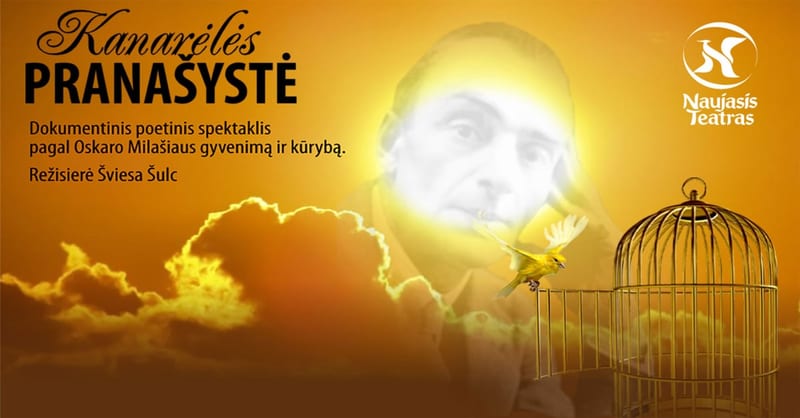
The Canary's Prophecy (a documentary play about Oscar Milosz)
SAT, 20 FEB · 16:00
Naujojo teatro kamerinė salė · A.Jakšto g. 9
From €19.20Tickets ↓
About this event
Dear audience,
On November 8 at 4:00 PM, due to important reasons, only one part of the play "The Canary's Prophecy" (written and directed by Šviesa Šulc) will be performed.
We would like to inform you that viewers holding tickets for the November 8 performance will be able to attend this play again by choosing a date convenient for them according to the repertoire announced by the New Theatre. To arrange a visit for a new time, please contact us via email at info@naujasisteatras.lt or by phone at +370 602 27321.
Thank you for your understanding, and we look forward to seeing you at the New Theatre.
Sincerely, The New Theatre Team
The New Theatre presents – a two-part documentary play about Oscar Milosz, "The Canary's Prophecy". The play reveals different stages of the life and work of the poet, diplomat, and mystic O. Milosz.
Part 1 "Seven Solitudes". Here you will have the opportunity to get to know the poet's grandparents, parents, and his life up to the age of 33. Oscar Vladislas de Lubicz Milosz was born and raised on the Chereya estate. After the partition of the Polish-Lithuanian Commonwealth between Russia and Prussia, the area belonged to the Russian Empire (Mogilev Governorate). Today, it is Belarus (Vitebsk Region). The poet's childhood and youth were difficult: coming from an old noble family of the Grand Duchy of Lithuania, but having received no love or tenderness in childhood, he remained lonely his entire life. The Parisian bohemia of the late 19th century and the everyday life of the tsarist Russian province at the beginning of the 20th century – all this shaped the young poet's personality, his relationships with people, and his creative and spiritual quests. Naturally, you will be able to enjoy Oscar's poems in French and Lithuanian. His first poetry collection, "Le Poeme des Decadences" (1894), is full of painful emotions and symbols of disillusionment with life, permeated with cynicism and a cry of death. In the second, "Les Sept Solitudes" (1906), the poet deepens the painful thought of his loneliness even further. The collection contained all the world's sadness over a lost childhood, the longing for a true home, the search for meaning, and a hopeless sense of futility and existential emptiness. And what about love? It will be there too... How did Milosz discover God, having been raised in an atheistic spirit?.. What event determined the great poet's desire to unlock secrets and hear the whisper of the canary spirits?.. At that time, the First World War was taking place; Oscar continued to write poems and wrote three mysteries. "This is truly extraordinary beauty - I think I will be able to die in peace. I write day and night, until five or six in the morning, and at noon I sit down at my desk again. I no longer eat or sleep. P.S. You know, one must work." All this and more, dear viewers, you will see when you come.
When & where
FEB
APR


