Exhibition
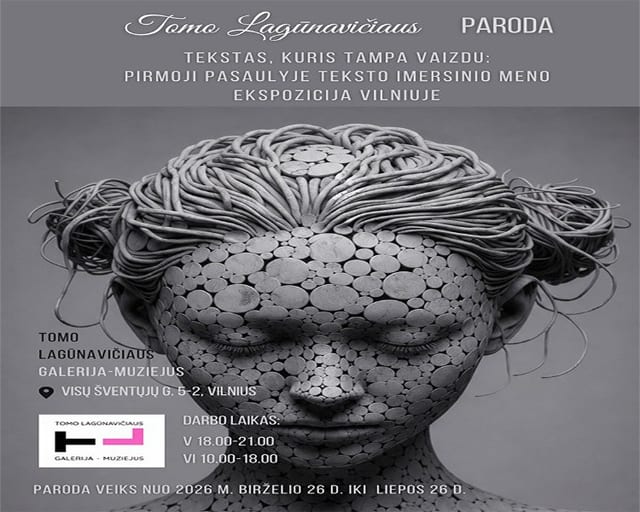
Text that becomes image: The World's First Text immersive art exhibition in Vilnius
About this event
We kindly invite everyone to visit the gallery-museum at Visų Šventųjų St. 5-2, Vilnius.
The author of the exhibition is artist Tomas Lagūnavičius.
The exhibition will be open: from June 26, 2026, to July 26.
Over the last decade, Vilnius has become one of the most prominent centers for contemporary art in the Baltic region. The art galleries operating here consistently present international projects that explore new forms of art, viewer experience, and contemporary societal issues. Recent exhibitions are increasingly focusing not on the contemplation of an art object, but on engaging the viewer in an active process of interpretation.
In this context, the upcoming Text immersive art exhibition in Vilnius at the Tomas Lagūnavičius gallery-museum gains not only artistic but also philosophical significance. It invites us to rethink the very concept of a painting and asks whether painting today can be perceived as text, and text as a visual experience.
Between painting and philosophy
Since antiquity, Western aesthetics have distinguished between image and word. One was associated with sight, the other with thought. However, 20th-century conceptual art began to dismantle this boundary. Text became a means of artistic expression, and language became a tool not just for description, but for creation.
The idea of Text immersive art extends this tradition in a new direction. Here, the word is not an explanation next to a painting. It becomes the painting itself.
Letters, sentences, philosophical concepts, and fragmentary narratives form a visual composition where color, form, and language act as equal aesthetic elements.
The viewer becomes a reader
The works in this exhibition do not offer one correct perspective.
On the contrary – each painting requires time.
Looking here gradually transitions into reading, and reading into interpretation.
This means that the work does not exist as a finished form. It is born in the consciousness of each visitor.
From this perspective, Text immersive art is close to Umberto Eco's concept of the "open work," according to which an artwork is not a finite meaning, but a field of possibilities for interpretation. At the same time, it resonates with Jacques Derrida's thought that meaning is constantly deferred and never finally completed.
Immersion without screens
Today, the term "immersive art" is most often associated with projections, artificial intelligence, or virtual reality technologies. However, this exhibition offers a different path.