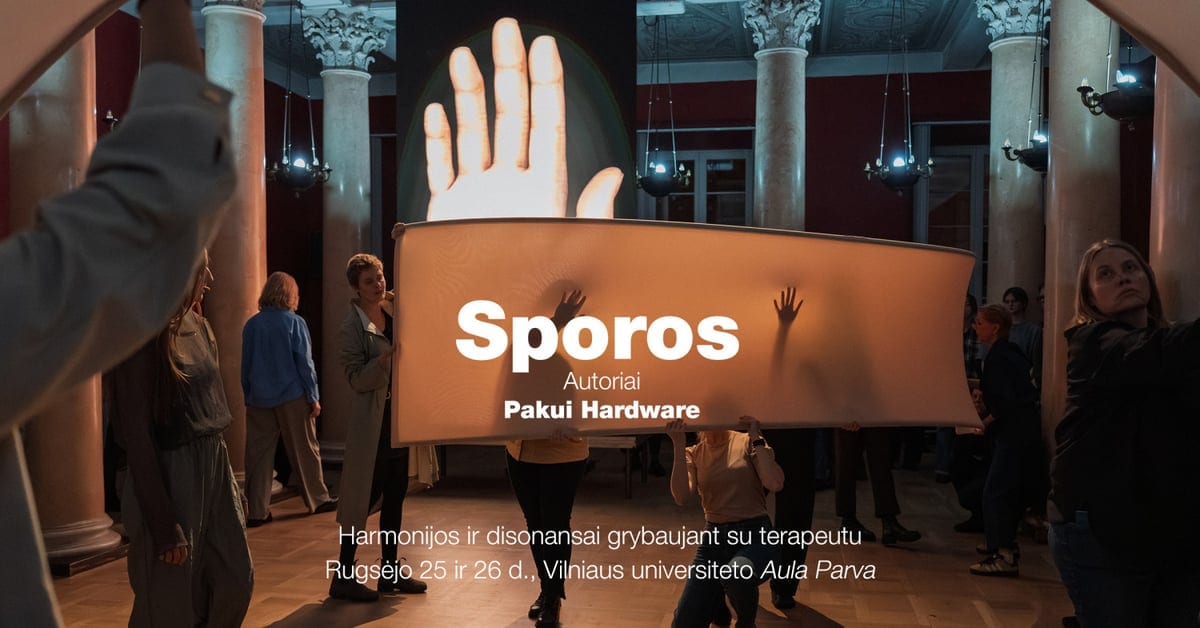
Friday, September 25, 2026, at 6 PM and 8 PM Saturday, September 26, 2026, at 6 PM and 8 PM
2nd Lithuanian Performing Arts Platform Vilnius International Theatre Festival "Sirenos"
Spores Harmonies and dissonances while mushroom picking with a therapist
The musical performance "Spores" explores the contemporary entanglement of emotional health and technology, of live and virtual support. The protagonist of the piece is one of many people in the modern world, trying to confide her anxiety to a therapist amidst a flood of information and emotional stimuli. True, this therapist is virtual—an advisor drawing on the wisdom of artificial intelligence. Their conversations, based on Western therapy theories, help navigate the turbulent waters of daily worries and grievances. However, by unconditionally supporting the patient, this advisor encourages dependency and creates an artificially positive environment—reflecting the desires and emotions expressed to it like a mirror. Are these virtual psychotherapists an Ariadne's thread helping to find a way out of the labyrinth of gloomy thoughts and emotions, or does this thread only further tangle and knot the dependencies on technology?
The work is inspired by the principles of classical Greek drama, adapted to current reality: here, the protagonist's internal transformations are accompanied by the voices of a chorus. Classical Greek tragedy, taking place today behind the doors of a psychotherapist's office or on phone screens, allows us to look at the changed relationship between the individual and the community. Is virtual care a truly sustainable salvation from emotional chaos, or should we be looking for other ways to build connections with ourselves, others, and the world? "Spores" is the debut performative work by the visual arts duo "Pakui Hardware," created together with a large team of performing arts creators. Contemporary electronic music, polyphonic sound structures performed live by a community choir, video-sculptural scenography, and movement patterns—all of this becomes a new, performative, pulsating body grown from individual spores.
Authors and directors: "Pakui Hardware" (Neringa Černiauskaitė and Ugnius Gelguda) Text authors: "Pakui Hardware" and the artificial intelligence therapist Composer: Miša Skalskis Curator of vocal practices: Vaidas Bartušas Co-author of solo vocal parts: Justina Mykolaitytė Choreographer: Andrius Katinas Scenographers: "Pakui Hardware" Costume designer: Morta Nakaitė Video artist: Vaclovas Nevčesauskas Lighting designer: Julius Kuršys Sound engineer: Ignas Juzokas Architect: Sigita Simona Paplauskaitė Dramaturgy consultant: Gediminas Rimeika
Performers: Justina Mykolaitytė (protagonist), Eglė Rudokaitė (organ), "Spores" choir – Smiltė Bagdžiūnė, Aistė Baltraitytė, Dalia Baltrušaitienė, Alexandra Bondarev, Akvilė Brazauskaitė, Vitalija Fokienė, Greta Germanavičiūtė, Laima Gric, Viktorija Jakštienė, Akvilė Jančauskaitė, Vytautas Juzėnas, Vėjūna Kaktavičienė, Danutė Kryžanauskienė, Marija Lenkaitė, Kristina Mickevičienė, Karilė Mozerytė, Daiva Petelienė, Aušrinė Rinkevičiūtė, Gabija Rostovskytė, Justė Savickienė, Raminta Šumskytė Sum, Dovilė Verikienė, Remigija Vilniūtė, Agnė Zeziulevičiūtė, Inna Zvinkli, Rugilė Žukaitė
Producers: "Operomanija", "Performa" Partners: Contemporary Art Centre, Lithuanian Culture Institute, "Iškrovos" Sponsors: Lithuanian Council for Culture, Vilnius City Municipality
The connections between today's technologies and bodies and their health have been the subject of our research almost since the beginning of "Pakui Hardware." We are interested in how technological progress changes bodies themselves, how every cell is harnessed for economic productivity, while simultaneously seemingly facilitating our daily tasks and communication. Recently, we have increasingly noticed that technology is taking over not only physical body transformations but also emotional health. Such a sensitive, intimate part of us suddenly becomes open to the technological gaze, and we willingly surrender to it. Thus, the idea was born to create a musical performance that would intertwine the classical genre of tragedy and the modern technologized lifestyle. We wanted to rethink the structure of tragedy itself, where the protagonist talks to otherworldly beings, only they are not on Olympus but on a phone screen, and the chorus, as the voice of society, now expresses itself in the comments section. Delving into psychotherapy provided by artificial intelligence, we realized that its limitation is not only technical but also cultural, i.e., based on purely Western therapy theories that do not always take into account the cultural specificities of each user, a certain cosmology brought with them, characteristic of the region from which he/she/they originate. We wanted to question not only the prevalence of AI therapy itself but also the established forms of therapy imported from the West: perhaps there are other, non-linguistic ways to create a relationship with oneself, one's past, and those around us—regardless of whether they are humans or non-human beings?
Pakui Hardware
While composing music for "Spores," I aimed to create a sonic fabric where natural and synthetic sounds would organically merge, connecting live choral sound, the soloist's voice, and electronic music. I sought to reflect the vision of "Pakui Hardware" in the music, their research on the body, materiality, and technological interfaces, while contrasting it with the charisma of the community choir and the "DIY" spirit. This is a new experience for me, requiring not only technical or musical solutions but also sensitivity to the ensemble, the space, and the themes.
Composer Miša Skalskis
This musical performance was created for the Vilnius contemporary opera festival NOA and the "Lithuanian Pavilion Without Walls" program of the New York-based performance biennial "Performa."
English language (a translation of the work's text into Lithuanian is distributed to the audience before the event)
Duration: 60 minutes
Premiere: October 23, 2025, Vilnius University Aula Parva
Critical reviews
I would like to highlight the excellent work of the protagonist, Justina Mykolaitytė. In "Spores," Justina reveals herself as a talented vocal performer; her natural yet very flexible voice convincingly conveys the message of urban loneliness witnessed in this piece.
Rasa Murauskaitė-Juškienė, 7 meno dienos
The "Spores" choir plays an essential role in the piece—it is the most genuine choir, the body and voice of the work, a conscious community where each member is interesting in their vocal and presence traits. Such authenticity can only be maintained by a group gathered from amateur musicians, not constrained by professional criteria, yet reliable, capable of balancing between "singing oneself" and "singing from the score." Ultimately, a strong community is also almost therapy.
Rima Jūraitė, menufaktura.lt
An EVENT-EXPERIENCE (!) was born, which can already be boldly called one of the most memorable works created on the Lithuanian stage in the last few years.
Ugnė Kačkauskaitė, menufaktura.lt
The choral parts, in particular, are characterized by an unexpected emotional density: their polyphonic sound creates a communal "body," like a network of spores, which acts as a counterpoint to the protagonist's isolation and reminds us that mental health is not just a personal matter but is accessible in connected fellowship. In these fragments, the work reaches a moving resonance.
Qingyuan Deng, Cultbytes.com
The performance is like an operatic therapy, inspired by classical Greek drama, adapted for the age of artificial intelligence and musical theater.
Yonatan Eshban-Laderman, Impulsemagazine.com
"Spores" breaks down established categories and reflects the increasingly hybrid nature of contemporary performance.
Marilena Borriello, Flash---art.com
Charismatic performer Justina Mykolaitytė, a vocal virtuoso and co-author of the songs, could have carried the whole show alone. Soon, the audience becomes an inseparable part of the performance. It is hard to describe the thrill you feel when a stranger standing next to you in the crowd suddenly starts singing.
David Ebony, Artworld.snapeditions.com