VILNIUS·KAUNAS
LT·EN
Scena
Scena
  • Discover
  • Films
  • Theater
  • Events
City
VILNIUS·KAUNAS
Language
LT·EN
  • Discover
  • Films
  • Theater
  • Events
Scena

Films, stages, concerts and nights out across the city — gathered into one live programme, updated daily.

Browse

  • What's on
  • Discover
  • Films
  • Theater
  • Events
  • Venues

© 2026 Scena · Where the City Happens

  • Search events, venues, dates, or what to do next.
↑↓navigate↵openescclose
  • Discover
  • Films
  • Theater
  • Events
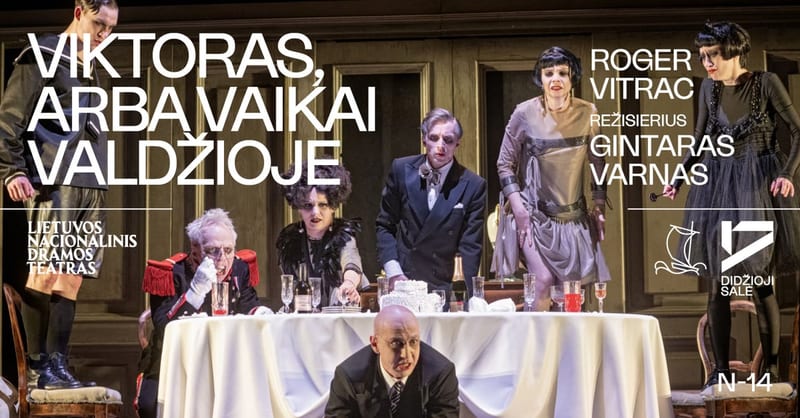
Roger Vitrac. VICTOR, OR POWER TO THE CHILDREN, dir. Gintaras VARNAS
Theater

Roger Vitrac. VICTOR, OR POWER TO THE CHILDREN, dir. Gintaras VARNAS

When & where

THU · OCT
1518:30
Tickets ↗
Details
Organizer
Lietuvos nacionalinis dramos teatras

About this event

Translated from French by Vincentas Klipčius

Director — Gintaras VARNAS

Set Designer — Gintaras MAKAREVIČIUS

Costume and Makeup Designer — Juozas STATKEVIČIUS

Composer — Martynas BIALOBŽESKIS

Lighting Designer — Vilius VILUTIS

Assistant Director — Regina GARUOLYTĖ

Producer — Rugilė PUKŠTYTĖ

CAST

Victor, 9 years old — Šarūnas Rapolas MELIEŠIUS

Charles Paumelle, Victor's father — Vainius SODEIKA

Emilie Paumelle, Victor's mother — Miglė POLIKEVIČIŪTĖ

Lili, the maid — Radvilė BUDRYTĖ

Esther, 6 years old — Rūta JONIKAITĖ

Antoine Magneau, Esther's father — Marius REPŠYS

Thérèse Magneau, Esther's mother — Elzė GUDAVIČIŪTĖ

General Étienne Lonsegur — Vytautas ANUŽIS

General Étienne Lonsegur — Arūnas SAKALAUSKAS

Madame Ida Mortemart, The Great Lady — Aurelija TAMULYTĖ

Doctor — Povilas BUDRYS

With the play "Victor, or Power to the Children," director Gintaras Varnas seeks to continue his long-standing cycle of surrealist theater (Federico García Lorca’s "Once Five Years Pass," "The Public," "Sombras," Guillaume Apollinaire’s "The Breasts of Tiresias," etc.). The greatest directorial inspiration was the social criticism reflected in the work. According to the director, it could be a kind of chamber variation of Aldous Huxley’s "Brave New World."

The director speaks out against the primitivization and modernization of theater and, with his production, raises the question of whether a small person does not have the right to destroy the prevailing stereotypical and established social order. According to him, it is a witty satirical parable of the 1920s about a family and a false, hypocritical, cowardly, and philistine world of "well-being" created by parents, which is gleefully destroyed by rebellious little anarchists, nihilists, and hooligan children; therefore, it is to be expected that today, in the 2020s, it should resonate in a new way.

Roger Vitrac (1899–1952) was a French surrealist writer, playwright, and poet. Born in Pinsac, the creator moved to Paris in 1910. From 1922 to 1928, he participated in surrealist activities, published a Dadaist manifesto, edited the magazine "Aventure," and contributed to the first issues of "La Révolution Surréaliste."

© OpenStreetMap, CARTO
VenueLietuvos nacionalinis dramos teatras, Mažoji salė

Gedimino pr. 4

What's on at this venue →

Gradually separating from the group with Antonin Artaud, they co-founded the Théâtre Alfred Jarry in 1926, where they wrote some of their most important surrealist plays. The play "Victor, or Power to the Children" was the second collaboration between Vitrac and Artaud. It premiered in Paris at the Théâtre de la Comédie des Champs-Élysées on December 24, 1928, on Christmas Eve.

While creating this play, Artaud and Vitrac dreamed of a virtual reality theater that would resist the banal tradition of linear, narrative Western theater. The play depicts the phantasmagorical ninth birthday party of Victor, the two-meter-tall son of Paul and Emilie Paumelle. Throughout all three acts, provocative scenes followed one another and confirmed the claims of Artaud’s manifesto: "The spectators who come to our theater will feel that they are participating in a real action, in which not only the mind but also the feelings and the body are involved. From now on, they will go to the theater as they would to a surgeon or a dentist – with the same mood; of course, they will not die, but theater is a serious matter, and they will not leave it healthy... They must know that we can make them weep."

The surrealist play "Victor, or Power to the Children" is a satire close to the theater of the absurd, mocking bourgeois conformism and the linguistic clichés used to mask secret hatred and cruelty. The work ironically dismantled the prevailing stereotypical view of marriage, religion, and the logic-defying alleged order, directed against the morality of the philistine middle class, the institution of the family, or society in the general sense.