Exhibition
Rasa Justaitė-Gecevičienė
Toxic garden
About this event
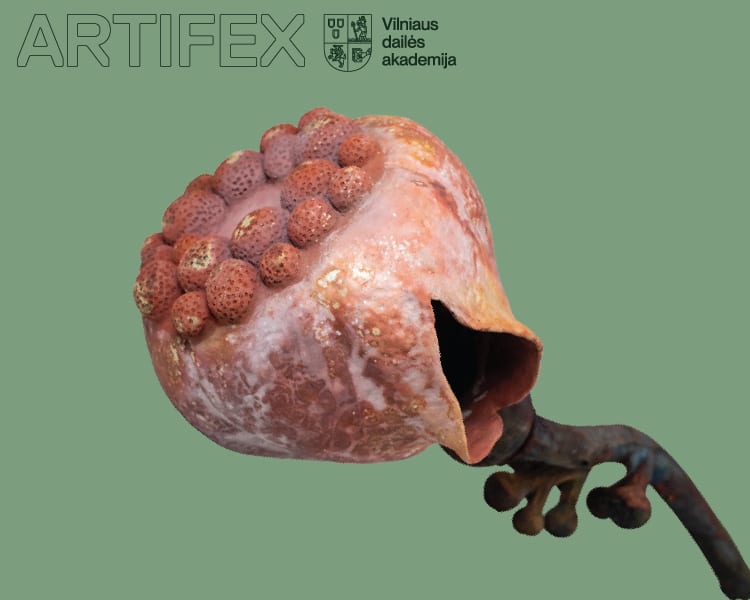
Until July 10, the VDA gallery "Artifex" will host Rasa Justaitė-Gecevičienė's solo exhibition "Toxic Garden".
Ceramics / a living laboratory with modified objects.
// One of the main aspects of my work is the synthesis of biology and art, but in this project, it takes on a more philosophical nuance. In this context, toxic plants are not just biological objects. Toxicity here is perceived not only as a chemical property but also as a cultural and emotional state.
I constantly work with plaster molds that I take from real plants and various objects. I cast plaster molds so that we can clearly see the plant's surface and its texture. Later, I use clay stamping and casting techniques with different clay bodies, and the formed and multiplied objects turn into new plants and landscapes. This process resembles preservation – as if I were stopping time, saving the surface, texture, and traces of growth.
In this creative and technological process, the stories of the plants are no less important – where and how they came to me. Friends flew monstera fruits to me from India because these plants do not bear fruit in our climate zone, only impressive leaves. Magnolia fruits arrived from the gardens of Rome. A broccoli that I managed to grow in my own garden (only one!). An artichoke from the store, which I chose for so long that people around me started asking for recipes. I had to admit – I was only interested in the form, not the culinary art. I really like that some fruits have animal names – for example, snake fruit or dragon fruit.
However, by copying and multiplying forms in clay, I am no longer creating natural plants, but their mutations – new organisms born from memory and material. In this way, the garden becomes an artificial ecosystem where naturalness and artificiality intertwine, and toxicity can be both biological and conceptual.
Some ceramic objects are placed in glass cylinders, resembling laboratory vessels. They look like the results of experiments or dangerous specimens, protected from the outside. It is like an archive for the future – not only about the plants that grow today, but also about the human desire to change, control, and isolate them.
"Cooper matte" and raku reduction, crackle and metallic effect glazes, "foil saggar" and horsehair effects act here as an additional element of risk and uncertainty. During firing, the result is never fully predictable, just like any intervention in a living system. And the sensitivity to light reminds us of fragility, because even a fixed object remains vulnerable.