Theater
LNDT
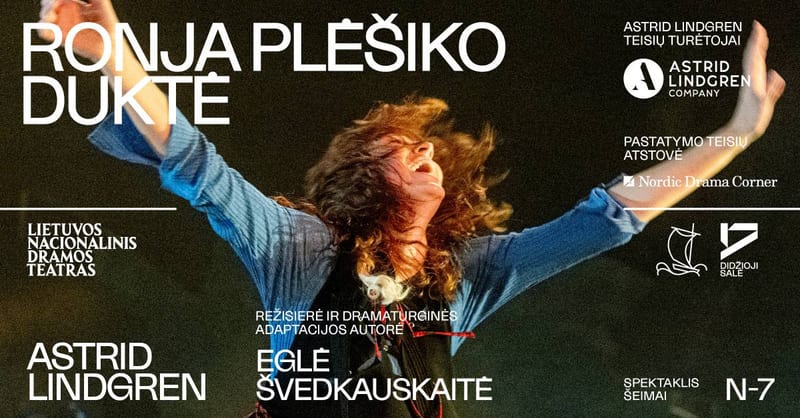
Astrid Lindgren. RONJA, THE ROBBER'S DAUGHTER, dir. Eglė ŠVEDKAUSKAITĖ
SAT, 19 DEC · 14:00
Lietuvos nacionalinis dramos teatras, Didžioji salė · Gedimino pr. 4
From €15Tickets ↓
About this event
Director and author of the dramaturgical adaptation — Eglė ŠVEDKAUSKAITĖ
Scenographers — Jurgis PAŠKEVIČIUS and Monika JANULEVIČIŪTĖ
Costume designer — Elvita BRAZDYLYTĖ
Composer — Agnė MATULEVIČIŪTĖ
Choreographer — Erika VIZBARAITĖ
Lighting designer — Julius KURŠYS
Assistant lighting designer — Jurij KOROLIOV
Assistant director — Kotryna SIAURUSAITYTĖ
Assistant costume designer — Haroldas KULIEŠIUS
Assistant costume designer — Ieva VAIČIULYTĖ
Producer — Kamilė ŽIČKYTĖ
Producer — Žiedūnė DUBNIKOVAITĖ
Cast
Ronja — Irena SIKORSKYTĖ
Mattis, Ronja's father — Algirdas DAINAVIČIUS
Lovis, Ronja's mother — Airida GINTAUTAITĖ
Birk, Bork's son — Šarūnas Rapolas MELIEŠIUS
Bork; Dwarf — Arūnas SAKALAUSKAS
Undis; Harpy — Elzė GUDAVIČIŪTĖ
Skalle-Per, Mattis's robber — Povilas BUDRYS
Harpy — Jolanta DAPKŪNAITĖ
Harpy — Jurga KALVAITYTĖ
Harpy — Jūratė VILŪNAITĖ
Fjosok, Mattis's robber; Dwarf — Vainius SODEIKA
Klippan, Mattis's robber; Rumpenisse — Marius Michailas REPŠYS
Tjegge, Mattis's robber; Harpy; Dwarf — Augustė POCIŪTĖ
Sturkas, Mattis's robber; Dwarf — Kęstutis CICĖNAS
Bork's robber; Harpy; Dwarf — Augustė Ona ŠIMULYNAITĖ
Bork's robber; Rumpenisse; Dwarf — Arūnas VOZBUTAS
Bork's robber; Harpy; Dwarf — Vaidilė JUOZAITYTĖ
Translated from Swedish by Eugenija Stravinskienė
On a forest-covered hill, in a castle split by lightning, lives Ronja – a girl born into the family of the robber chieftain Mattis. Her days are spent playing with the robbers and being pampered by her parents, while beyond the castle walls awaits an introduction to a magical forest full of dwarves, harpies, and other extraordinary creatures. Meanwhile, Mattis looks at his growing daughter, hoping that Ronja will take over the leadership of the robber gang from him.
Their usual daily life, filled with robbery, gatherings, and songs, is pierced like another bolt of lightning by the news that on the other side of the castle, Mattis's mortal enemy Bork has settled with his gang. Along with Bork's robbers lives Bork's son, Birk. Upon seeing him for the first time, Ronja feels that this is exactly the kind of small person like herself that she had always longed for and waited for. Although at first the children, like their parents, compete and stubbornly hold their ground, gradually, as they experience adventures and trials together, they become friends. Their secret friendship becomes a challenge not only for the children but also for the robber gangs, and later turns into running away from home into the forest.
"Ronja, the Robber's Daughter" is one of the most famous works by the renowned Swedish children's author Astrid Lindgren (1907–2002). Her books have been translated into more than 95 languages. Astrid Lindgren has won dozens of awards, including the Hans Christian Andersen Medal – the highest international award given to children's writers and book illustrators. The author created such legendary, world-famous characters as Pippi Longstocking, Karlsson, and Emil of Lönneberga.
"Ronja came about because I myself, living in the city, really missed the fields and the deep forest. It started with me imagining a mountain, on the mountain a robber's castle, which suddenly split in half. 'What kind of people live there?' I thought. Aha, one robber family has a daughter, and the other has a son. Just like Romeo and Juliet. At first, they fight, tease each other, but gradually they become friends..." the author has said.
"Ronja is a girl who dares to choose her own path. And although she is very similar to her father, she cannot agree with his view of the world and stay in his castle; she must experience for herself what friendship means, what it means to love and to lose. Children who run away from home to freedom not only mature in the forest but also show adults that the only path to strength is to learn to coexist and unite. It seems to me that the lessons written in Astrid Lindgren's work are incredibly relevant and important now. Our production of 'Ronja, the Robber's Daughter' is a musical, witty, and at the same time deep coming-of-age story," says the play's director and author of the dramaturgical adaptation, Eglė Švedkauskaitė.
The play features Agnė Matulevičiūtė's "Wolf's Lullaby," performed by the 4th-grade boys' choir of the "Ąžuoliukas" music school (artistic director Vytautas Miškinis, choirmaster Daiva Leipuvienė).
Copyright representative – "Nordic Drama Corner" agency
The play is funded by: The Ministry of Culture of the Republic of Lithuania
When & where
DEC