Theater
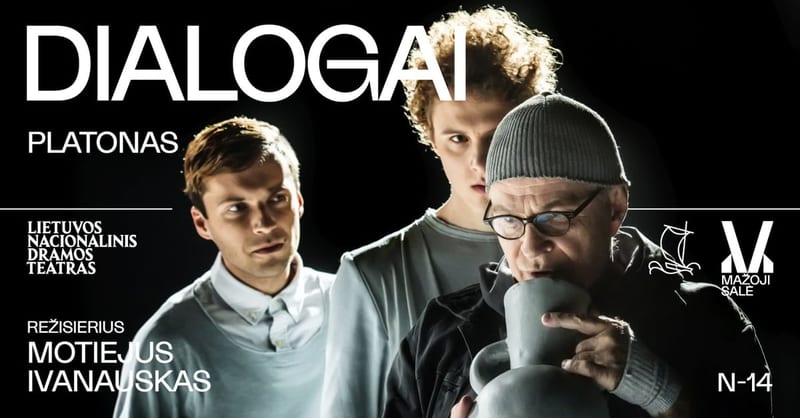
Plato. DIALOGUES dir. Motiejus IVANAUSKAS
WED, 21 OCT · 19:30
Lietuvos nacionalinis dramos teatras, Mažoji salė · Gedimino pr. 4
From €12.20Tickets ↓
About this event
Author of the adaptation and director — Motiejus IVANAUSKAS
Scenographer — Izabelė NAREČIONYTĖ
Costume designers — Izabelė NAREČIONYTĖ, Dovilė GUDAČIAUSKAITĖ
Composer — Matas SALADŽIUS
Lighting designer — Vilius VILUTIS
Assistant director — Regina GARUOLYTĖ
CAST
Socrates — Vytautas ANUŽIS
Polemarchus, Glaucon, Polus, Agathon — Povilas JATKEVIČIUS
Thrasymachus, Gorgias, Hippias, Meletus — Šarūnas ZENKEVIČIUS, Motiejus IVANAUSKAS
Voice, Diotima — Elzė GUDAVIČIŪTĖ
The play uses works translated from Ancient Greek: Plato's "Symposium" and "Apology of Socrates" (translated by Merkelis Račkauskas), "Republic" (translated by Jonas Dumčius), "Gorgias" (translated by Tatjana Aleknienė), as well as fragments from Xenophon's "Memorabilia" (translated by Vanda Kazanskienė) and Aristophanes' "The Frogs" (translated by Antanas Dambrauskas).
In 2019, Motiejus Ivanauskas won the Young Creators Platform competition organized by the LNDT. The theme he proposed for the theater – to bring to life on stage the "Dialogues" written by Plato (the thoughts of his teacher, Socrates, recorded by Plato) – seemed worthy of further development to the jury.
Motiejus Ivanauskas, who recently finished his acting studies at the Lithuanian Academy of Music and Theatre, says: "Many things testify that a 'golden mean' is often important in life. In other words – a balance between two opposite poles. This applies to psychology, politics, and the structure of the new play. In 'Dialogues', what draws attention is that Socrates' teachings seem to clearly encourage the pursuit of 'eternal values-virtues' – wisdom, moderation, the cultivation of will – but at the same time, one feels the 'free' atmosphere of ancient Greece, Socrates' ironic attitude towards himself, his interlocutors, and the reflections he proposes himself. This immediately sets a favorable tone, because Socrates does not consider himself omniscient, but simply brings to the surface certain problems, which then become obvious to everyone."
Socrates – the main character of "Dialogues", who will be played by Vytautas Anužis – would bluntly tell his contemporaries what he thought about them and their actions, and would support his reasoning with solid arguments in such a way that the interlocutors were often left disappointed because they realized they could no longer object. However, Motiejus Ivanauskas says that he certainly does not want to create a didactic work, using Socrates' wisdom as a standard of truth (Socrates himself, who often said "I know that I know nothing", would likely not agree with that). A much more effective principle seems to be when the episodes are simply left to "float" among the audience, leaving the possibility to laugh, object, or perhaps – agree.
When & where
OCT
NOV
JAN


