VILNIUS·KAUNAS
LT·EN
Scena
Scena
  • Discover
  • Films
  • Theater
  • Events
City
VILNIUS·KAUNAS
Language
LT·EN
  • Discover
  • Films
  • Theater
  • Events
Scena

Films, stages, concerts and nights out across the city — gathered into one live programme, updated daily.

Browse

  • What's on
  • Discover
  • Films
  • Theater
  • Events
  • Venues

© 2026 Scena · Where the City Happens

  • Search events, venues, dates, or what to do next.
↑↓navigate↵openescclose
  • Discover
  • Films
  • Theater
  • Events
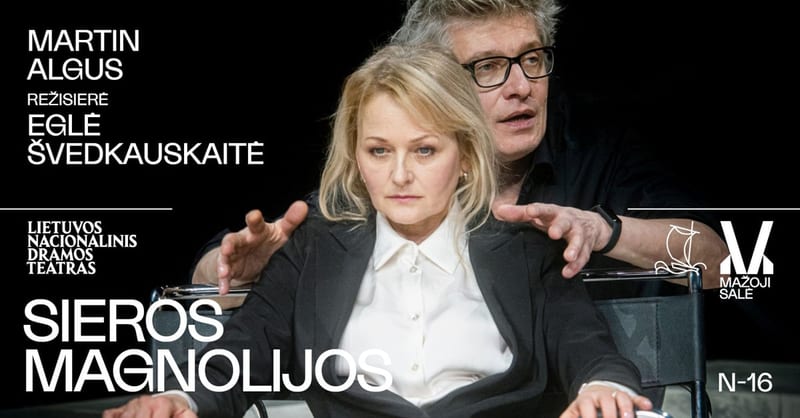
Martin Algus. MAGNOLIAS OF SULFUR, dir. Eglė ŠVEDKAUSKAITĖ
Theater

Martin Algus. MAGNOLIAS OF SULFUR, dir. Eglė ŠVEDKAUSKAITĖ

TUE, 20 OCT · 19:30
Lietuvos nacionalinis dramos teatras, Mažoji salė · Gedimino pr. 4
Tickets ↓
Details
Organizer
Lietuvos nacionalinis dramos teatras

About this event

On October 20, the play MAGNOLIAS OF SULFUR will be performed with English subtitles. Subtitles are best viewed from rows 6-10.

Director, adaptation author — Oliver FRLJIĆ

Set designer, video projection author — Igor PAUŠKA

Costume designer — Morta NAKAITĖ

Artist - Dainius URBONIS

Assistant director — Augustas GORNATKEVIČIUS

Producer — Agnė PULOKAITĖ

CAST

Rasa SAMUOLYTĖ, Rimantė VALIUKAITĖ, Gediminas RIMEIKA, Aistė ZABOTKAITĖ, Algirdas GRADAUSKAS, Kęstutis CICĖNAS, Marius Michailas REPŠYS, Rytis SALADŽIUS, Augustė ŠIMULYNAITĖ, Vaidilė JUOZAITYTĖ, Jūratė VILŪNAITĖ, Toma VAŠKEVIČIŪTĖ.

You can kill a man, but you cannot force him to be someone else. (Robert Antelme)

How, when, and why do we stop looking at the Other as a human being? At the very core of Franz Kafka's work, one can always detect the examination of different forms of dehumanization. The story of Gregor Samsa, who turned into an insect, raises the question of the limits of our empathy for others: how the process of identification takes place, how the Other is constructed, and whether we are capable of accepting the Other as part of humanity. This play aims to examine the complex dialectical relationship between two different political (in the broad sense) mechanisms: empathetic identification on one hand, and dehumanization on the other.

The field of meaning in Kafka's works is incredibly broad and does not yield to simple, unambiguous interpretations. In order to open up their different levels, the most important thing in the play is to establish a dialogue with the reality in which we live.

On July 28, 1914, the First World War began, and just a few days later, F. Kafka began writing his most famous novel, "The Trial" (which remained unfinished and was published without the author's permission only after his death). And although these two events are not linked by mutual causality, the experience of war is evident both in this and in other works by the author. Kafka scholars argue that in "The Trial," he foresaw the totalitarian ideologies that soon engulfed Europe, and also predicted the nature of that war. When Russia started the war against Ukraine on February 24, it was said that this war would begin the next stage of European history and introduce a new world order. Thus, it may be that we, Europeans of the 2020s, like Kafka, who became a contemporary of the First World War, will experience an era of upheaval after which a new order will prevail in the world.

When & where

OCT
NOV
TUE · OCT
2019:30

Lietuvos nacionalinis dramos teatras, Mažoji salė

Tickets ↗
© OpenStreetMap, CARTO
VenueLietuvos nacionalinis dramos teatras, Mažoji salė

Gedimino pr. 4

What's on at this venue →

Franz Kafka (1883–1924) was a prominent Austrian novelist who wrote in German. He is considered one of the most unique and influential writers of the 20th century, a pioneer of modernism, and is also cited by surrealists as one of their precursors. Born into a Jewish family, he studied chemistry and German studies, later choosing Law studies, much to the delight of his domineering father, who considered his literary ambitions to be futile delusions. He worked almost his entire life at the Prague Workers' Insurance Company, immersing himself in the world of literature during his free time from the bureaucratic work he hated. He constantly felt a contradiction between his social life and his creative calling, and suffered greatly because of it. He was extremely strict with his work, and a significant portion of his works were published without his consent only after the writer's death.

Being hermetic and polysemous, F. Kafka's prose provides opportunities for various interpretations, often the most contradictory ones. His works reveal a strange, difficult-to-explain world full of threat and fear, the instability of that world, loneliness, fatigue, and fear for the future.

Oliver Frljić (b. 1976) is one of the most prominent European theater creators, a director, actor, and playwright, often called a "theater provocateur" by critics. On stage, he usually raises complex and uncomfortable questions for society, speaks sharply on social topics, and in his work, he usually reacts to current problems and situations of the day. More than one of his plays has caused a significant resonance in society, such as his play about antisemitism in Poland, which became a prominent and scandalous event in neighboring Poland when it was canceled at the Old Theater in Krakow in 2013, or the play "The Curse" staged at the Powszechny Theater in Warsaw in 2017. The director is invited to create on various stages and is also a resident at the Gorki Theater in Berlin.