Music
LVSO
Violin star christian tetzlaff and lvso
About this event
É. Lalo. Symphonie espagnole
J. Brahms. Symphony No. 3 in F major, Op. 90
Christian Tetzlaff, violin
Lithuanian State Symphony Orchestra
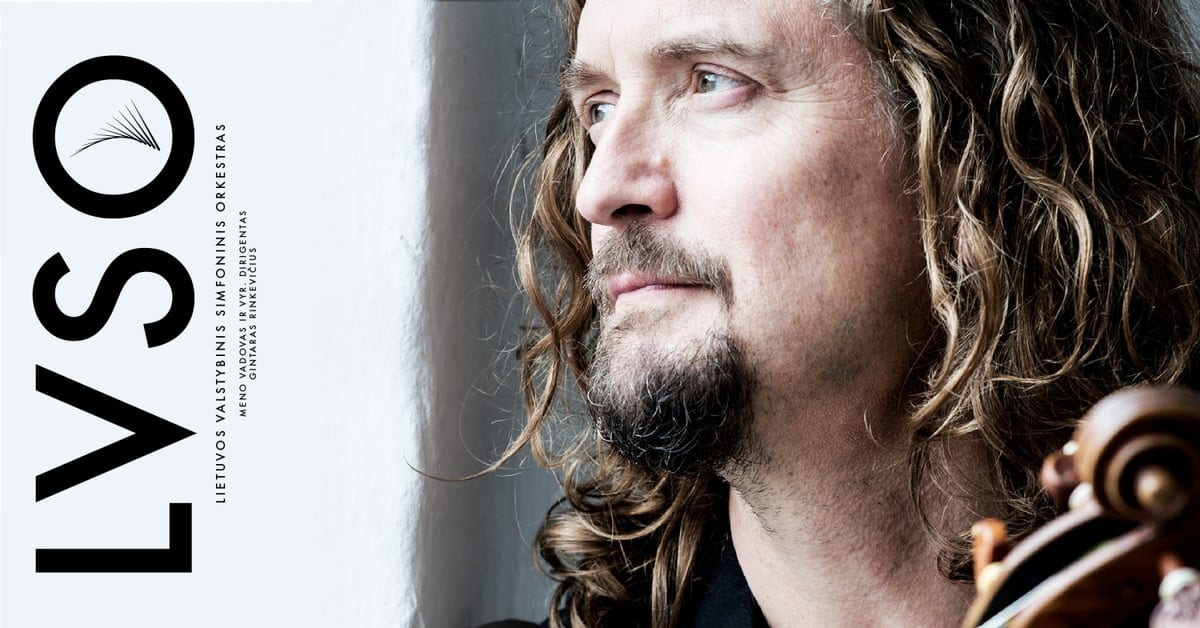
Conductor Gintaras Rinkevičius
The Lithuanian State Symphony Orchestra offers a unique opportunity to hear one of the most impressive violin stars on the classical music scene, Christian Tetzlaff. The violinist is highly regarded worldwide for his expressive, insightful, and personal interpretations. His distinctive approach to the score and constant search for emotional and compositional depth have long gathered a circle of loyal listeners who often describe his performances as an existential experience.
Ch. Tetzlaff has performed with all the world's most prominent orchestras: the Berlin, Vienna, and New York Philharmonics, the Boston, Chicago, Royal Concertgebouw of Amsterdam, London, and many others. His repertoire is vast – from J. S. Bach's solo sonatas and partitas to the less frequently performed concertos by G. B. Viotti and J. Joachim, as well as contemporary works by G. Ligeti, J. Widmann, and Th. Adès. In 2015, the British daily "The Guardian" described Ch. Tetzlaff's interpretation of L. van Beethoven's Violin Concerto with the London Symphony Orchestra, conducted by Daniel Harding, as "the best performance of this work I have ever heard." Since 2012, Ch. Tetzlaff has been a professor at the Kronberg Academy, and in 2023, he became the artistic director of the "Spannungen" music festival in Heimbach (Germany).
For the concert in Vilnius, Ch. Tetzlaff has chosen French composer Édouard Lalo's (1823–1892) "Symphonie espagnole," which modern music critics consider a work in the violin concerto genre. Written in 1847, the piece saw the light of the Parisian stage during a period when Spanish motifs in music became extremely fashionable.
In the second part of the concert, the Lithuanian State Symphony Orchestra will perform Johannes Brahms' (1833–1897) Third Symphony, distinguished by its vibrant orchestration, ingenious rhythmic and metric flexibility, and excellent organic development. After hearing the symphony, Antonín Dvořák wrote in a letter to publisher Fritz Simrock: "I can say without exaggeration that this work surpasses J. Brahms' first two symphonies; if not in grandeur and power, then certainly in beauty. What wonderful melodies are here!" A. Dvořák's enthusiasm was well-founded: the premiere of this symphony in 1883 with the Vienna Philharmonic Orchestra received great acclaim.