Music
LVSO
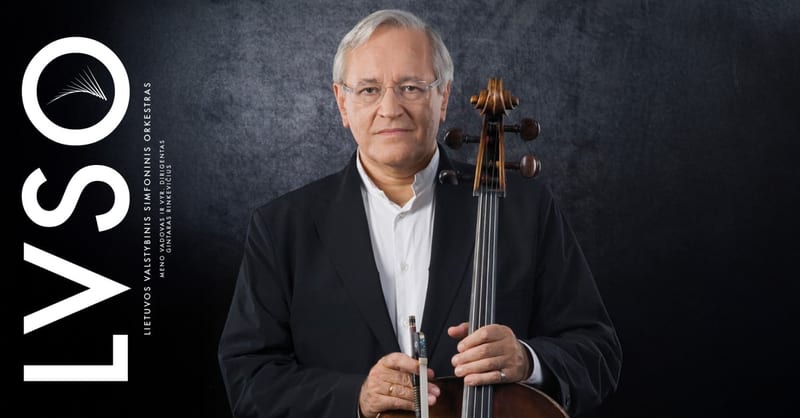
David geringas jubilee concert
About this event
W. A. Mozart. Symphony No. 40 in G minor, K. 550
A. Dvořák. Cello Concerto in B minor, Op. 104
David Geringas, cello
Lithuanian State Symphony Orchestra
Conductor Gintaras Rinkevičius
One of the most prominent cello virtuosos in the world, belonging to the modern elite of classical music, David Geringas celebrates his 80th birthday. The artist's incredibly broad repertoire, spanning from the early Baroque to contemporary music, highlights the musician's extraordinary curiosity, exceptionally high technical mastery, and inner flexibility. Intellectual precision, stylistic versatility, and an intuitive sense of melody and tone have earned the musician special respect and recognition worldwide.
Born in Vilnius, the artist studied at the M. K. Čiurlionis School of Art in the cello class of Mikhail Senderov. In 1968, he graduated from the Moscow Conservatory under the legendary cellist Mstislav Rostropovich. After winning the gold medal at the International Tchaikovsky Competition in 1970, the then 24-year-old cellist, M. Rostropovich's favorite student, opened the doors to the world's most famous concert halls. Throughout his career, D. Geringas has performed as a soloist with the world's most renowned symphony orchestras: the Berlin, Vienna, Zurich, Chicago, and London Philharmonics, as well as those of Montreal, Tokyo, and others. The cellist has received numerous prestigious awards, including two "Echo Klassik" awards and a "Grand Prix du Disque" for his recording of twelve cello and orchestra concertos (conducted by Bruno Giuranna). Prominent contemporary composers have dedicated many works to D. Geringas, and his discography consists of over 120 recordings. Having dedicated many years to pedagogical work, D. Geringas has trained such well-known performers in his legendary cello class as Gustav Rivinius, Jens Peter Maintz, Wolfgang Emanuel Schmidt, Monika Leskovar, Tatjana Vasiljeva, Jing Zhao, Johannes Moser, Maximilian Hornung, and Sol Gabetta.
In 1975, the cellist emigrated to Germany; he currently lives in Berlin and has been teaching at the Accademia Chigiana in Siena since 2005. In 2002, D. Geringas was awarded the Lithuanian National Prize for Culture and Arts, and in 2008, he was granted an honorary doctorate by the Lithuanian Academy of Music and Theatre. In 2023, the cellist was presented with a Lifetime Achievement Award at the International Classical Music Awards (ICMA).
At the anniversary concert, D. Geringas will perform Antonín Dvořák's (1841–1904) Cello Concerto in B minor – one of the most famous concertos of this genre in the world, also known as the "great" or "royal" concerto. The melodic thematic material and instrumentation of the work allow one to be transported to the refreshing landscapes of the composer's beloved Bohemia.


