Theater
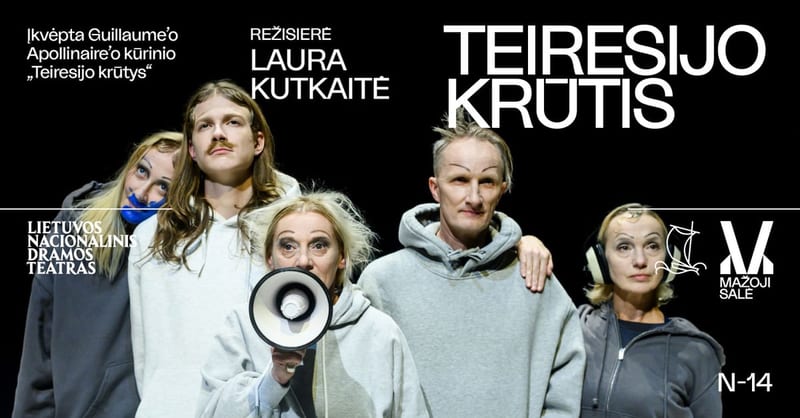
Laura Kutkaitė and the actors. THE BREASTS OF TIRESIAS, dir. Laura KUTKAITĖ
About this event
Director and dramaturg — Laura KUTKAITĖ Text authors — Guillaume APOLLINAIRE, Laura KUTKAITĖ, Aistė ZABOTKAITĖ, Domantas STARKAUSKAS, Rytis SALADŽIUS, Vitalija MOCKEVIČIŪTĖ, Dalia MICHELEVIČIŪTĖ Set and costume designer — Paulina TURAUSKAITĖ Composer — Agnė MATULEVIČIŪTĖ Choreographer — Agnietė LISIČKINAITĖ Lighting designer — Julius KURŠIS Assistant director — Kotryna SIAURUSAITYTĖ Assistant dramaturg — Gintarė ILGINYTĖ Producer — Vidas BIZUNEVIČIUS
CAST
Aistė ZABOTKAITĖ
Domantas STARKAUSKAS
Rytis SALADŽIUS
Vitalija MOCKEVIČIŪTĖ
Dalia MICHELEVIČIŪTĖ
In her second production at the Lithuanian National Drama Theatre (in 2022, she was awarded Best Young European Director at the Fast Forward festival in Dresden for her debut work "The Silence of Sirens"), Laura Kutkaitė takes inspiration from the surrealist work "The Breasts of Tiresias" by French poet, playwright, and novelist Guillaume Apollinaire (1880–1918) and, together with the actors, constructs a new text without committing to the original play. Together with the creative team and the actors, a surreal world based on the principle of associations is created, which in its logic sometimes resembles the one that surrounds us more than one might wish.
In G. Apollinaire's work, the blue-faced figure Thérèse rebels against her husband. She grows a beard and a mustache and shouts about how masculine she feels. Thérèse becomes Tiresias (a blind prophet figure in Greek myths), so Thérèse's husband decides to give birth to children himself, and at the end of the work, Thérèse returns to the one she was running from.
"Reading the play, I was strongly affected by two things: the depiction of a woman as strong only when she is a man, the equating of a woman with her womb, and perhaps most strongly of all – Thérèse's return to her husband. I want to immerse the audience in a kaleidoscopic, choreographic dream created on the principle of associations. I am interested in creating a performance as a stage poem. I want to bring Thérèse back to the Husband once more, meet an older Thérèse, and ask her: would she regret this step, or would she feel sorry for it? This becomes an almost insurmountable rhetorical question related to people's beliefs, imposed social constructs, and the deeply rooted concepts of femininity and masculinity. Due to their strong feminist position, my performances are similar to manifestos, but there is always a tear hidden within them. At the epicenter of this work is a very huge doubt about manifesting itself. With this performance, I am not asserting, but questioning. That is why, for the first time, I feel hope.


