Exhibition
Jeruzalė. Six Decades in the Garden: Teodoras Kazimieras Valaitis
About this event
Exhibition of works by Teodoras Kazimieras Valaitis (1934-1974) at the Vladas Vildžiūnas Gallery
On July 9 at 7 p.m., the Vladas Vildžiūnas Gallery presents the exhibition "Jeruzalė. Six Decades in the Garden: Teodoras Kazimieras Valaitis." The evening will feature improvisations by Jan Maksimovič and Eugenijus Kanevičius.
It so happens that we only remember the artists of our "golden fund" every decade, marking birth or death anniversaries. But even this is meaningful, as a new generation grows up for whom the work of these artists is a new, unseen, interesting, and relevant experience. This was confirmed by the highly popular exhibitions held between 2022 and 2024 at the Vladas Vildžiūnas Gallery, featuring Vladas and Marija Vildžiūnas and Kazimiera Zimblytė. A natural continuation of this exhibition cycle is Teodoras Kazimieras Valaitis, who joins the ranks of the "silent modernists" who, in the 1960s-1980s, frequented the home of Vladas and Marija Vildžiūnas in Vilnius' Jeruzalė, together creating an "oasis of free-thinking" where socialist realism templates were broken and authentic creative ties were forged with the free world behind the Iron Curtain.
The last solo exhibition of Valaitis, dedicated to commemorating the jubilee dates of the artist's birth and death, was held in July 2024 in Palanga at the Antanas Mončys House-Museum. It lasted less than a month, so the exhibition in Vilnius' Jeruzalė essentially extends it and supplements it with a new context related to the Vildžiūnas home and the history of the sculpture garden, returning Valaitis' works to these spaces after a 22-year hiatus.
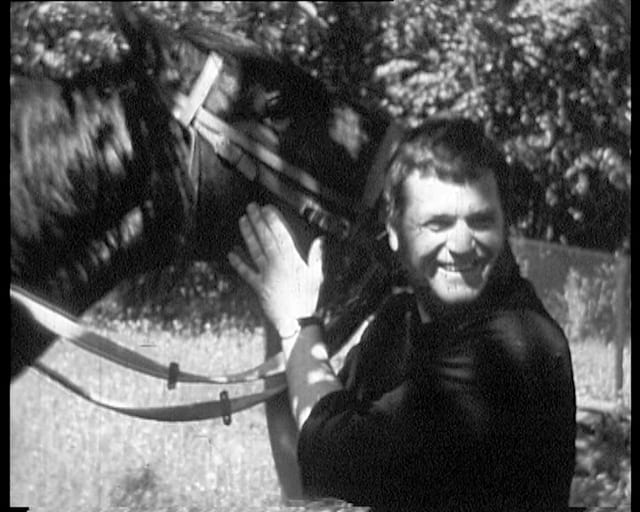
Perhaps for many of the older generation, an almost textbook image emerges from memory: "Teodoras rides in on a black horse straight from the Riešė stables to visit us in Jeruzalė that summer of 1973 (a year before his death). Like a romantic knight, he circles the green meadow around Vladas' queen 'Barbora'" (A.M. Sluckaitė-Jurašienė). These are some of the few documentary shots by V. Vildžiūnas that captured him alive... In the autumn of 1974, Valaitis dies in a fire. In his studio – an entire treasure trove of unrealized ideas. In the garden, several sculptors carve an oak monument in a day and a half. S. Kuzma, L. Virbickas, and Š. Šimulynas work in shifts.
Vladas Vildžiūnas' friendship with Valaitis, which began during their student years (at the Vilnius Art Institute), continued with interruptions until the artist's death. They were united by an interest in world modernist giants – H. Moore, C. Brancusi, J. Arp, A. Calder, J. Lipchitz – as well as an understanding/intuition of monumentality in sculpture. Even after Valaitis' death, Vildžiūnas and close family friends took care of Valaitis' legacy, its dissemination, and implementation in durable materials (the "A hūm" exhibition in Japan; the sculpture "Anchor" in the Jeruzalė Sculpture Garden; the enlarged and bronze-cast Valaitis sculpture "Warrior," etc.).
Teodoras Kazimieras Valaitis (1934-1974) is undoubtedly one of the most prominent Lithuanian modernists of the second half of the 20th century, a universal and intellectual creator, remembered by contemporaries and friends as a Renaissance man, an aristocrat of the spirit. "He lived and created with great ambition, challenging a closed society shackled by fear, playing an adventurous, dangerous game with fate" (A.M. Sluckaitė-Jurašienė). Known for the free and bold solutions in restaurant interiors (most of which have been destroyed) and Soviet exhibition pavilions abroad, which are classified as decorative art, Valaitis also had another side, that of a "silent modernist," which unfolded through "pure art," a part of his work that is less known but no less interesting and modern. There are only a few publicly visible works by Valaitis, the most famous being "Vėtrungė" (Weather Vane) in the Lazdynai district of Vilnius. Therefore, it is relevant and meaningful to remember this "silent" work of Valaitis, which is being exhibited at the Vladas Vildžiūnas Gallery: sculptures made of bronze, foam, and plaster, hammered metal reliefs, bronze casts, composites based on foam and clay sculpture originals, brass sculptures restored from original cardboard structures (restored by G. Kavaliauskas), painting, drawings, and sketches. The sculpture "Sun Bird," newly cast from a foam original, is being shown after a long hiatus – the foam original was exhibited in Valaitis' posthumous exhibition in 1975 and had been missing for a long time afterward. Many drawings and sketches are framed and exhibited for the first time.
The exhibition items were loaned by Mariana Bruni and Gediminas Kavaliauskas, Aušra Petrauskaitė, and several works are from the Vildžiūnas collection.
During the exhibition, the gallery's black hall will screen archival documentary material about Valaitis – shots captured by V. Vildžiūnas' 16mm film camera featuring Valaitis in Vilnius' Jeruzalė, at the wedding of Jonas and Aušra Jurašas, Valaitis' studio, Valaitis' works in interiors, and from the 1975 posthumous exhibition. During tours, it will also be possible to watch the LRT "Legends" show about T. K. Valaitis (dir. A. Stonys, host A. Stonytė-Budzinauskienė, 2016).
Visiting the exhibition: Thu-Sat from 12 p.m. to 7 p.m. by prior arrangement via phone: +37068578257 or email: laura.vjss@gmail.com.
Facebook: Vlado Vildžiūno galerija. Jeruzalės skulptūrų sodas
Exhibition organizer: Public Institution "Vilnius Jeruzalė Art Center."
The project is funded by the Lithuanian Council for Culture and partially funded by the Vilnius City Municipality.
Photo: T. K. Valaitis in the Jeruzalė Sculpture Garden in 1973. A frame from the documentary filmed by V. Vildžiūnas.


