Exhibition
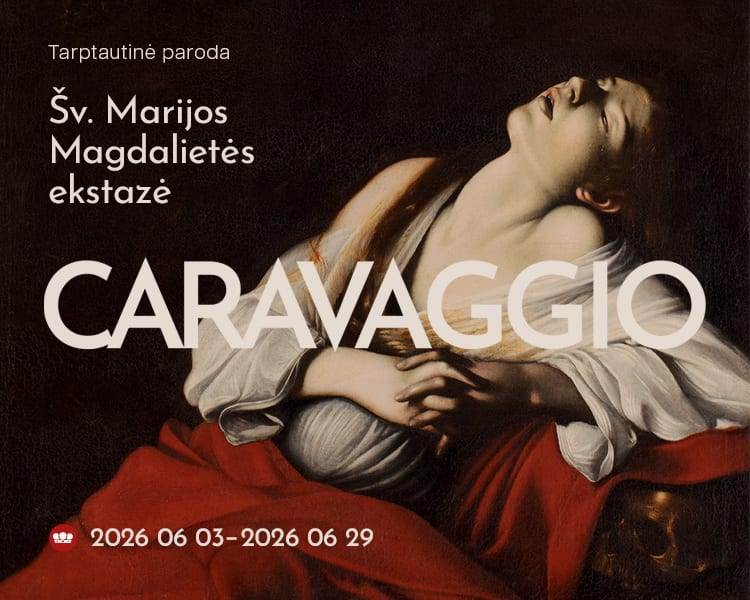
International exhibition "Caravaggio. Ecstasy of Saint Mary Magdalene"
About this event
For the first time in Lithuania, a masterpiece by one of the leading painters of the Baroque era, Michelangelo Merisi (1571–1610), known as Caravaggio, is being exhibited: 'The Ecstasy of Saint Mary Magdalene'.
Caravaggio is one of the most famous and influential painters of all time. It is Caravaggio who is often considered the pioneer of Baroque art, opening up a completely new age of cultural thought, forms, and even the viewer's relationship with art, not only for Italy but for all of Europe.
Here, while still very young, Caravaggio became the most popular and controversial painter of his time. The artist often chose homeless people and prostitutes as his models. The figures painted according to the idealistic criteria of Renaissance paintings were gradually replaced by representatives of the lower social strata, exhausted by poverty, deprivation, and spiritual and physical suffering, who, in Caravaggio's opinion, best embodied the ideals promoted by the saints. Everyone wanted to acquire Caravaggio's works. In just a decade, the artist sparked a true revolution in painting.
This international exhibition presents the painting 'The Ecstasy of Saint Mary Magdalene', which had been considered lost since the beginning of the 17th century. It is likely that this was the very painting Caravaggio took with him on his final journey to Rome, hoping that Pope Paul V would grant him a pardon, as he had been sentenced to death for murder. However, the painter never reached Rome – exhausted by illness during the journey, he died near the town of Porto Ercole.
Two of the three paintings that Caravaggio carried as gifts for his patrons on this journey were considered lost. The work exhibited, 'The Ecstasy of Saint Mary Magdalene', was discovered in 2014 in a private collection in Switzerland, where it had been passed down from generation to generation by its owners, unaware of its true value and authorship. The most prominent experts on Caravaggio's work, Prof. Mina Gregori and Prof. Bert Treffers, unhesitatingly identified it as one of the genius's works that had gone missing in 1610 while he was traveling to Rome.
This discovery sparked enormous interest among art historians and the cultural community. The painting was restored and exhibited in many countries over several years, with exhibitions dedicated to it held even in Tokyo, New Delhi, and elsewhere, and now the work has reached Vilnius.
This is the first time that one can become acquainted with the work of this genius in Lithuania. This initiative was conceived as part of the cultural program implemented by Italian institutions in Lithuania, in response to the Year of Lithuanian Culture in Italy in 2025–2026 and the commemoration of the 80th anniversary of the Italian Republic in Vilnius.