Exhibition
HOMO SAPIENS: THE SEEKING HUMAN An exhibition of stained glass, sculpture, and painting by Šalnė Balčiūnaitė
About this event
On August 4, Šalnė Balčiūnaitė's solo exhibition "Homo sapiens: the seeking human" was opened.
Painting, stained glass, and glass sculpture meet in this exhibition as three different approaches to one fundamental question – what does it mean to be human? Not in a biological or social sense, but as a constantly changing, erring, seeking, and self-recreating being.
This exhibition speaks about humanity as an uninterrupted process. What makes a human human? The body? Memory? The ability to think? Faith? Or perhaps mistakes? This is a question that has existed in Western philosophy from Antiquity to the present day, yet it has no single answer. Each era has defined the human differently: in one, they became the measure of the world; in another, the image of God; in yet another, a biological species or a product of social relations. However, none of these concepts exhaust what we intuitively call humanity. Perhaps that is why art continues to return to the human – not to define them, but to ask the same question again and again.
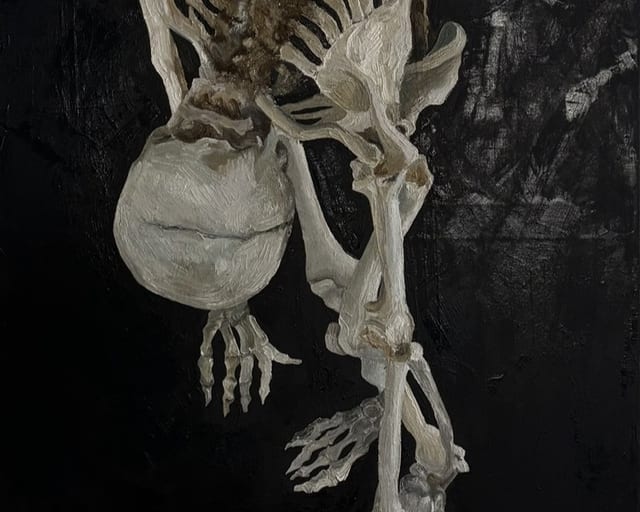
In the work of Šalnė Balčiūnaitė, the human is constantly transforming. In one piece, a child grows into an erring and seeking adult, and this adult eventually disintegrates, leaving only bones, yet even here, human anatomy is recognizable. These forms are not just life stages or symbolic allegories in the traditional sense. They are rather different states through which the same humanity unfolds. The body, material, and iconography change, but something harder to define remains – that which allows us to recognize ourselves in every figure.
It is no coincidence that there is almost no individual portraiture in the exhibition. Humanity here is not focused on facial features or individual identity; on the contrary, the further one moves away from the concrete, the more universal the human becomes. A skeleton has neither age, nor gender, nor social status. In the glass sculptures of children, individual consciousness is only just forming. Even the characters depicted in the stained glass represent not themselves first and foremost, but human experience – pain, guilt, forgiveness, hope. In this way, the viewer does not observe the stories of others, but gradually begins to recognize their own.
(excerpt from a text by Karolina Kupstaitė)
The exhibition will be on display from August 4–30. Visiting with a ticket.