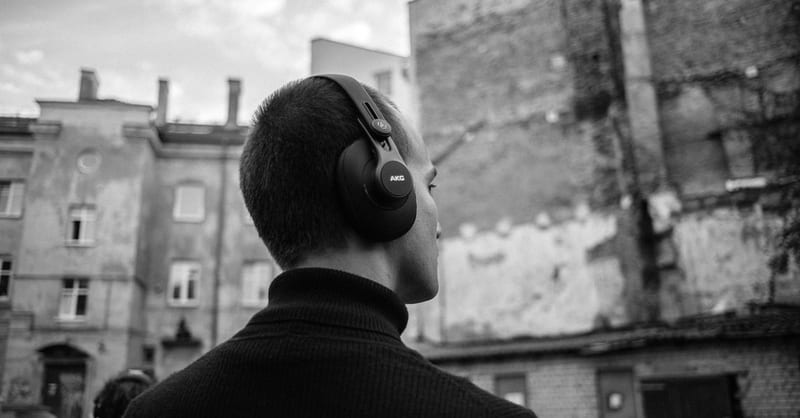
"Glaistas" (Putty) is a sound journey through the territory of the former Vilnius Ghetto and the cracking folds of memories of the Holocaust. The sound map of the journey is composed of musical fragments created specifically for each space, and the direction of movement is guided by the voices of four Holocaust survivors who moved from their native Vilnius to Israel after the war, recorded by the creators of "Glaistas" in interviews in Tel Aviv, Jerusalem, and Haifa in May 2019.
Frida Sohat (b. 1929) was imprisoned in the Vilnius Ghetto, and the Klooga (Estonia) and Stutthof (Poland) concentration camps. She moved to Israel in 1957 because she wanted to meet her father, who had survived the war.
Joshua Zak (1929–2024), after leaving Vilnius, settled in Haifa and became a professor of physics at the Israel Institute of Technology (Technion). In 1989, he discovered the Z(k) – the Zak phase, for which he was awarded the prestigious Wigner Medal in 2014.
Sore Voloshin (1928–2020) was the only survivor from a family of over 50 people in Vilnius. She was a cousin of Yitskhok Rudashevski, the young author of the Vilnius Ghetto diary, who was murdered in Paneriai.
Baruch Shub (1924–2020) was a participant in the Jewish underground movement during the war. After moving to Israel, he became a flight engineer. Until the end of his life, he gave lectures on antisemitism and was a member of various public organizations.
The sound document, as an artifact of memory, is the main axis of the work, around which musical interpretations of the streets, courtyards, corridors, apartments, halls, and other spaces of the former Vilnius Ghetto stretch. The interview fragments heard in them lose the function of a purely verbal narrative – the sound events captured in the recordings suggest themes for choirs or electronic compositions, individual stories take on the features of arias, and voices weave into soundscapes, becoming full-fledged means of musical expression. Everything is complemented by the extensive use of binaural recordings, which give the sounds heard in the headphones an impression of reality.
This is how the unique aesthetic of the "Glaistas" musical narrative is born, a dynamic contemporary Gesamtkunstwerk, in which the viewer's body and their movement in space also become important.
The work balances between moving "to those times" and returning "to today." Exploring the limits of the possibilities of such a transition, first and foremost in our own heads, the creative team does not hide from the fact that we are moving through today's Vilnius – rapidly changing, being painted and beautified, covered in construction netting, and in some places still waiting for a fresh layer of putty.
The creators, accompanying the viewers in chamber groups, invite them to look together at what is hidden under the putty and reflect on important questions: do the limits of understanding the Holocaust exist? Where does memory end and imagination begin (if this divide is possible at all)? In what forms does what was almost completely destroyed during the war return (or could it return)?
In 2020, the creative team of the sound walk in the Vilnius Ghetto "Glaistas" was awarded the "Golden Stage Cross" for best dramaturgy.
Reviews:
Although "Glaistas" connects the lost Jewish Vilnius (through reminiscences of its people, architecture, etc.) with today's version of the city, plastered over with cultural and barbaric layers, it speaks very truly and clearly not about the past tense, but about the present – what Vilnius is like today, without those voices that were claimed by the Holocaust.
Rima Jūraitė, menufaktura.lt
I have not experienced a better interpretation of the current ghetto theme – because it is, of course, a total experience. <…> It is very difficult to appeal to feelings without manipulating them – this is exactly what the authors of this work succeeded in doing. <…> Do not miss the opportunity. It is worth coming to Vilnius specifically for "Glaistas."
Lara Lampert, Head of the Judaica Research Center at the Martynas Mažvydas National Library of Lithuania
The great value of "Glaistas" is that the creators refuse to create a sculpture. They rather give a stone. <…> The created soundscape – although dense and multifaceted, is as cautious as breathing; leading to sensuality, drawing away from the field of meaning, also simply allowing one to breathe.
Dovilė Zavedskaitė, 7 meno dienos
The plot of the performance, like a cracking connection between the interviewees' memories and history, between languages and changing spaces, allows one not to hear or learn, but rather to feel or remember a dream already dreamt and therefore lived by someone else.
Rimgailė Renevytė, 7 meno dienos
The creators of "Glaistas" simply sacrifice themselves so that the murdered people might at least today find their guardian angels. This is the most beautiful and precious experience of "Glaistas." The creators, without waving facts around, without reproaching for the past, lead us on tiptoe and immerse us in the world around and within.
Daiva Šabasevičienė, Vilniaus galerija
Historical memory in this journey appears not as a reflection of factography, but as a drama existing in the actual present, constructed by unpredictable imagination, and experienced individually and subjectively.
Ugnius Babinskas, mic.lt
Creative team:
Authors: playwright Rimantas Ribačiauskas, director Mantas Jančiauskas, composers Jūra Elena Šedytė and Andrius Šiurys
The work uses sound recordings from interviews with Frida Sohat, Joshua Zak, Sore Voloshin, Baruch Shub
Performers who participated in the sound recordings:
Vocal ensemble "Melos": Justina Leinartaitė (soprano), Gabrielė Bilevičiūtė (soprano, ensemble leader), Karolina Macytė (soprano), Ieva Parnarauskaitė (soprano), Jūra Elena Šedytė (alto), Dainora Aleksaitė (alto), Gabija Adamonytė (alto), Milda Adamonytė (alto)
Sound engineer Vytautas Bedalis
Children's vocal ensemble: Patricia Dahl, Urtė Kretkovskytė, Ignas Masevičius, Kasparas Skuja
Choirmaster Skaistė Garbašauskienė
Lora Kmieliauskaitė (violin)
Kazimieras Jušinskas (saxophone)
Programmer Robertas Dumpis
Sound mastering by Arūnas Zujus
Translators: Rimantas Ribačiauskas, Ana Ablamonova, Olga Lempert, Darius Ross, Vsevolod Chernozub
Guides: Rimantas Ribačiauskas, Mantas Jančiauskas, Jūra Elena Šedytė, Andrius Šiurys, Ana Ablamonova, Paulina Simutytė, Ieva Parnarauskaitė, Medeinė Mickevičiūtė, Kristupas Gikas, Lyja Maknavičiūtė, Greta Štiormer, Marija Laenko, Justina Buslavičiūtė, Miglė Remeikaitė, Eglė Radavičiūtė, Jevgenijus Kovalčukas
Producer Operomanija
Main partner Jewish Culture and Information Center
Partners: LMTA Music Innovation Studies Centre, Vilnius Theatre "Lėlė", Audiovisual Arts Industry Incubator, Mama Studios, Lithuanian National Museum of Art
Duration: 80 minutes
Premiere: October 27 – November 3, 2019
Work in Lithuanian, English, Russian, Hebrew, and Yiddish with Lithuanian / English / Russian / Hebrew subtitles