Exhibition
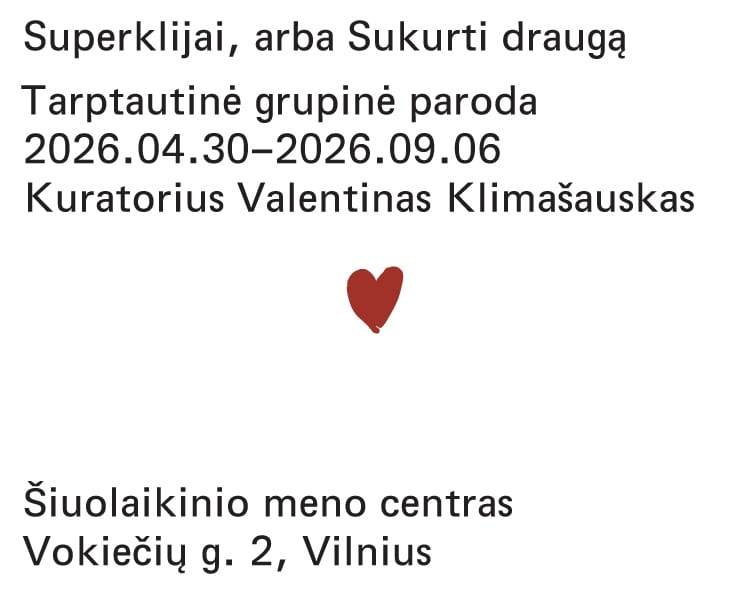
Exhibition "Superglue, or Creating a Friend"
About this event
The international group exhibition "Superglue, or To Create a Friend" marks a new chapter for the Contemporary Art Centre (CAC) – it is the beginning of the new director's exhibition program. Presenting primarily figurative art, the exhibition invites a rethinking of the CAC's relationship with its audience. The abundance of figures here creates an aesthetic and social environment based on diversity, which can both facilitate an encounter with the other and question identity (of the person, the depicted figure, the (post)human), the possibility of a connection with the other, and, at the same time, the authenticity and meaning of contemporary art.
Against the backdrop of intensifying global (and societal) polarization and fragmentation, the exhibition seeks to create conditions for a more open polemic about the changing relationship between contemporary art and the audience under the conditions of multiple crises. One of the exhibition's central starting points is an excerpt from director Algirdas Araminas's film "When I Was Small" (1968). It shows a school excursion through one of the first exhibitions at the then Art Exhibition Palace in Vilnius (the current CAC). The film emphasizes the viewer's difficult relationship with modernity: the provincial character played by actor Bronius Babkauskas bumps into the large windows of the exhibition palace – a symbol of modernist transparency. High culture is embodied here by the modernist exhibition and the mannered voice of the guide, while the class teacher performs a disciplinary function. This pressure brings a pair of students closer together: they escape the guided tour and form a romantic connection.
Looking back at historical and contemporary works, the exhibition "Superglue, or To Create a Friend" reflects on the encounter with the other through different concepts of the other, the prevalence of the posthuman figure, and contemporary art itself as something ultimately unknowable and alien. Assemblages of new and historical, individual and collective figures indirectly ask: what glue could connect a divided, belligerent, and rather narcissistic society today? What is the role of art in a world where opinions are becoming increasingly rigid? And in the hell of ideological excess, what would still allow us to think about relationships that open up authentic, unpredictable, non-commodified experiences – friendships or even the possibility of falling in love with another (rather than rejecting them)?
Figurative art has existed for at least 50,000 years, but over the last decade, there has been a clear return – and even inflation – of the figure in contemporary art. This phenomenon can be interpreted as a reaction to the uncertainty, disinformation, excess of speculation, simulation, hyperrealism, and big data that accompany the dominance of technology, as well as an attempt to take advantage of the opportunities provided by posthumanism, new materialisms, postcolonial perspectives, post-robotics, artificial intelligence, and other processes. By returning to the figure and narrative, strategies for creating and recognizing identity are being rethought.
The second part of the title – "To Create a Friend" – refers to the anti-ideological essay "Inventing the Enemy" by Italian philosopher and writer Umberto Eco. According to Eco, "having an enemy is important not only to define our identity but also to provide us with an obstacle against which to measure our system of values and, in seeking to overcome it, demonstrate our own worth. So when there is no enemy, we have to invent one." Today, there is no shortage of enemies, or antagonists, in either politics or the art world – the internal reconciliation that an external enemy usually helps to achieve never takes place.
Where did it all begin? Modernism, which contemporary art has continued, never promised to be friendly to the viewer. On the contrary – juggling military terms, for example, by declaring itself the art avant-garde and intending to sweep away the old order, it consciously enjoyed the negation and shocking of so-called philistine, bourgeois taste.
However, the relationship has changed today: the once-propagated strategy of "creating an (art) enemy" – mocking a public ignorant of art rules – has transformed into the efforts of museums and galleries to befriend the audience. Today, most cultural institutions create friend or patron programs (often paid) and strive to be more open. True, friendliness is often paid for at the cost of banalizing or vulgarizing the art experience: exhibitions and works are "explained," become illustrative, and leave no room for the viewer's undefined, personal relationship. Considering these dangers, the exhibition "Superglue, or To Create a Friend" inevitably balances between the attempt to create multifaceted, ambiguous, or even contradictory relationships between the art institution, the exhibition, the works, and the visitors – and the critique of these connections.
And what about now? What forces still drive us to create connections against the backdrop of increasing polarization, narcissism, constant networking, the commodification of relationships, multiple crises, and wars? Is it still possible to create a relationship with the other? Can we construct ourselves through the other in a positive way – seeing them not just as an enemy or a friend? If so – is this one of the functions of contemporary art? What scares us today – and what would we run away from in the exhibition? Finally: how can we, despite everything, become friends?