Dear audience,
The performance of RHINOCEROS scheduled for April 23, 2026, at 7:00 PM is being rescheduled to September 17, 2026, at 7:00 PM due to an actor's illness. Tickets already held by the audience will be valid for the new date and do not need to be exchanged.
If the rescheduled date does not suit you, you may return your tickets and receive a refund. Please submit your refund request here: https://www.bilietai.lt/apacia/howtobuy/23-66-20/ticket-refund-application
Tickets can be returned from April 30, 2026, to May 13, 2026.
We apologize to the audience for the inconvenience.
The performance of RHINOCEROS on September 17 at 7:00 PM will be the final showing. We invite you to attend and say goodbye to the production.
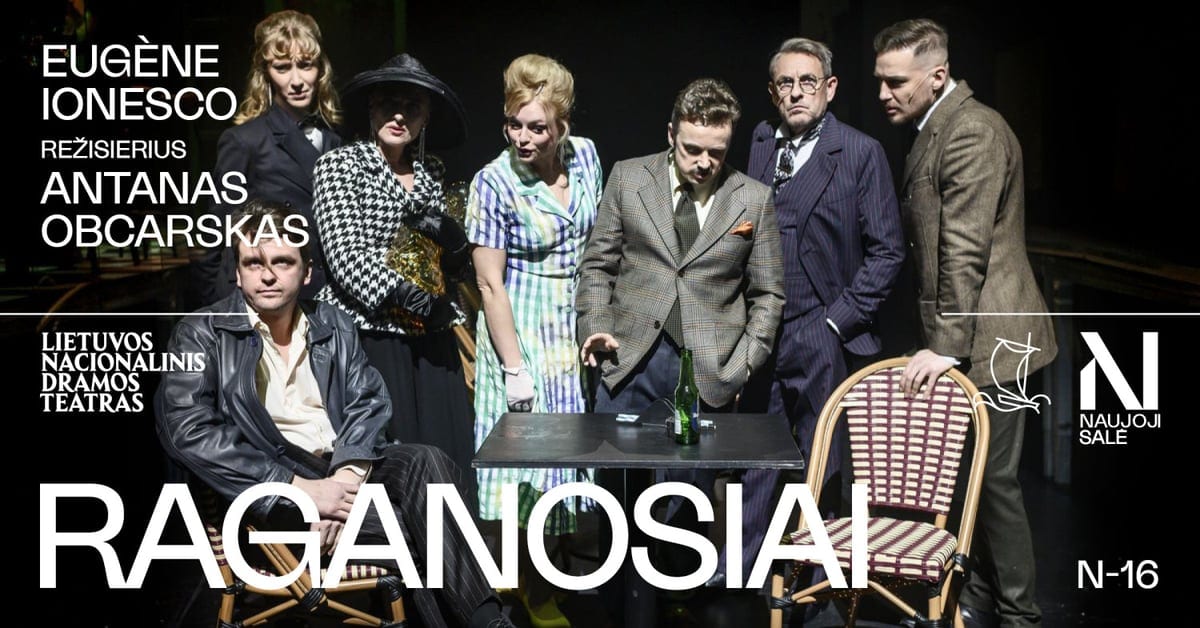
Director — Antanas OBCARSKAS
Set Designer — Lauryna LIEPAITĖ
Dramaturg — Valentinas KLIMAŠAUSKAS
Costume Designer — Juozas VALENTA
Composer — Agnė MATULEVIČIŪTĖ
Video Projection Authors — Adomas GUSTAINIS, Ričard ŽIGIS
Lighting Designer — Dainius URBONIS
Choreographer — Ieva NAVICKAITĖ
Cat Character Authors — Pakui Hardware (Neringa Černiauskaitė and Ugnius Gelguda)
Mask Author — Donatas JANKAUSKAS (Duonis)
Music performed by: — String Quartet "Chordos", Agnė Matulevičiūtė, Matas Samulionis, Dominykas Snarskis, Danielius Skeivelas, Gediminas Stepanavičius
Assistant Director — Deivydas VALENTA
Producer — Kamilė ŽIČKYTĖ
CAST
Berenger — Martynas NEDZINSKAS
Jean — Kirilas GLUŠAJEVAS
Daisy — Toma VAŠKEVIČIŪTĖ, Žygimantė JAKŠTAITĖ
Dudard — Kęstutis CICĖNAS
Old Gentleman Botard — Arūnas SAKALAUSKAS
Logician, Mr. Papillon — Gytis IVANAUSKAS, Marius REPŠYS
Woman with Cat, Mrs. Boeuf — Rimantė VALIUKAITĖ
Waitress — Aistė ZABOTKAITĖ, Vaidilė JUOZAITYTĖ
Proprietor — Naglis BIERANCAS
Translated from French by Vincentas KLIPČIUS
Rhinoceros are already in your city! Join the progress!
How fast they are. Strong. Monumental! Unwavering. Logical. And you? You do not exist because you do not think. Start thinking and you will appear. This is more than an invitation. Turn into a rhinoceros! Just look at how beautifully they roar! They sing and dance!
At first, maybe they were a minority, but now – definitely not. There are more and more of them. You will find your own kind there too. Your colleagues and neighbors. The entire elite is there. Your manager, the mayor, the most important influencers. It is easy to criticize from the sidelines, but the truth is only visible from the inside, only once you have joined. After all, you see what is happening – reality is changing before your eyes. After many crises, the world has changed beyond recognition. Keep up with the times.
So what will your choice be? Will you keep sitting in the café? One more small one? Or will you join? But will you succeed? Or will you remain the last human in your city?
On a quiet Sunday afternoon, representatives of various social strata gather in a café located in the square of a typical French provincial town. They talk about their lives and politics. These discussions help to understand the problems not only of France but of all of Europe. In the space of the café, the characters not only gather but also drift away from each other. Unexpectedly, rhinoceroses appear in the town and destroy everyday life, and the hallucination becomes a provocation.
"Rhinoceros" is one of the most famous plays by the Romanian-born French playwright Eugène Ionesco and one of the most popular comedies of the 20th century. Despite many features characteristic of the theatre of the absurd, as well as the playwright's body of work, "Rhinoceros" is considered one of E. Ionesco's most unusual pieces. The play depicts the gradual transformation of humanity into rhinoceroses, metaphorically conveying the collapse of personality and the human desire to be the same as everyone else, to merge with the mass. The playwright focuses on the individual and their place in society, and the longing for meaning deeply rooted in a person.
"I see E. Ionesco's play as a study of the modern world. Its four acts contain the situation of today's world: miscommunication, having a job one dislikes, along with a growing fear of losing it, different perceptions of reality, reflections on a community divided by populist ideas and becoming increasingly radical, and attempts to understand what a human and humanity actually are. Is a human being an obsolete relic?" ponders director A. Obcarskas. He says that by staging this play, he intends to reveal not only the most relevant but also the most comical nuances of "Rhinoceros".