Theater
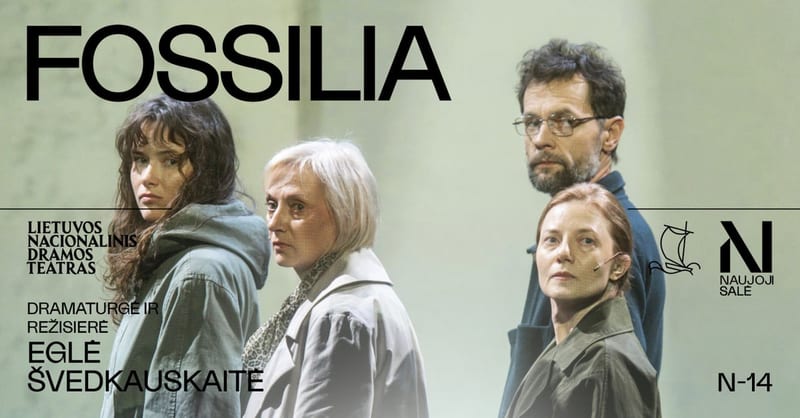
Eglė Švedkauskaitė. FOSSILIA, dir. Eglė ŠVEDKAUSKAITĖ
About this event
Director — Eglė ŠVEDKAUSKAITĖ Text authors — Dalia GRINKEVIČIŪTĖ, Eglė ŠVEDKAUSKAITĖ, Rasa SAMUOLYTĖ, Darius GUMAUSKAS, Ugnė ŠIAUČIŪNAITĖ, Povilas JATKEVIČIUS, Vitalija MOCKEVIČIŪTĖ Scenographer — Ona JUCIŪTĖ Costume designer — Dovilė GUDAČIAUSKAITĖ Composer — Agnė MATULEVIČIŪTĖ Author of the shell instrument — Elena LAURINAVIČIŪTĖ Lighting designer — Julius KURŠYS Video projection artist — Ieva Kotryna SKI Choreographer — Erika VIZBARAITĖ Dramaturgy mentor — Anna SMOLAR Producer — Vidas BIZUNEVIČIUS Assistant director — Kotryna SIAURUSAITYTĖ
CAST
Museum employee — Rasa SAMUOLYTĖ
Father — Darius GUMAUSKAS
Mother — Vitalija MOCKEVIČIŪTĖ
Son — Povilas JATKEVIČIUS
Daughter — Ugnė ŠIAUČIŪNAITĖ
Inspired by Dalia Grinkevičiūtė's work "Lithuanians by the Laptev Sea"
A son studying film art abroad receives an assignment to create a documentary sketch and, somewhat hesitantly, chooses his own family—Mom, Dad, and Sister—as his subjects. Upon returning to his native Kaunas, a real treasure awaits him: a museum employee invites the family to examine a manuscript of the father's aunt's memoirs about the Siberian exile, which had just been discovered in the garden of their grandparents' house. The young man begins to slowly explore not only the manuscript that had lain underground for fifty years but also his family's past, realizing how it shapes his family's relationships in the present.
Although E. Švedkauskaitė creates a fictional family for the play, she also relies on real facts: in 1991, in Žaliakalnis, Kaunas, at 60 Perkūno Alley, a jar was accidentally unearthed containing loose pages with Dalia Grinkevičiūtė's memories of Siberia. The manuscript was considered lost, as Grinkevičiūtė herself had tried to find it several decades earlier but failed. Dalia Grinkevičiūtė's work is not only one of the most poignant pieces of Lithuanian literature and a part of the school curriculum, but it has also been translated into fifteen languages. It is an impressive work of art about preserving humanity in inhumane conditions, or in the author's own words, a "monument to the victims of the North."
"I titled the play Fossilia thinking about everything that is unearthed in the context of the work—it is not just the jar with the manuscript, but also the characters' feelings and thoughts. In this play, we aim to depict a young person's need to ask their parents about family history and to analyze the experiences of the older generation. The stage action is driven by a young creator representing the so-called therapeutic generation, who are very eager to talk things out and 'resolve' relationships, to feel the security that knowledge provides. It is probably quite natural that we, having grown up in a world of open sharing, democratic order, and technology, ask questions, but often questions about the past and attempts to evaluate it escalate into confrontation. The relationship with parents is very important in this play; it is also important that young people are interested in the exile, not viewing this event as a museum exhibit, but wanting to understand how they would act in such a situation and whether they would be able to survive," says the play's director and playwright Eglė Švedkauskaitė.


