Exhibition
Danas Aleksa. Foot, forehead, palate, and key
About this event
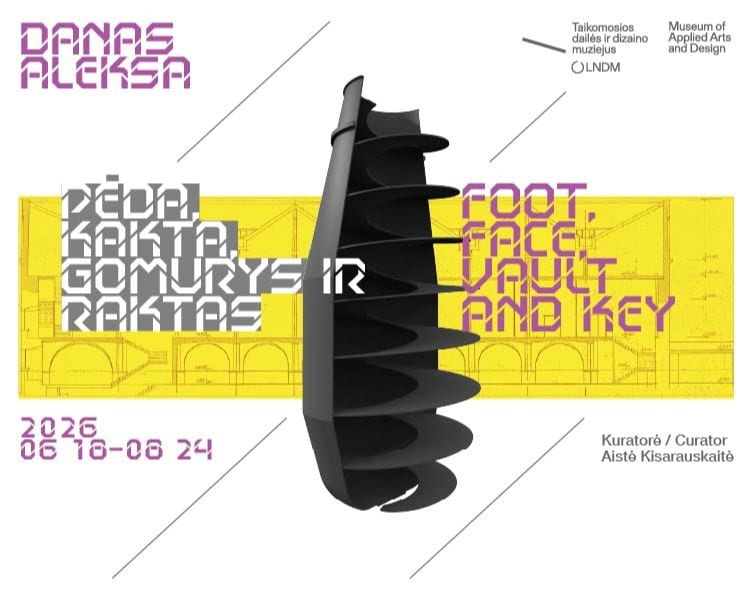
This exhibition is a singular work by contemporary artist Danas Aleksa, interpreting the history, architecture, and construction of the Museum of Applied Arts and Design. It employs specific terms, the primary one being the arch. It is surrounded by an aura of engineering discoveries, military victories, or sacred buildings, and we can observe the curves of reconstructed arches in the architecture of the hall where the exhibition takes place. Danas Aleksa reminds us that foot, forehead, and palate are terms forgotten by the builders who constructed arches, as arches have become a rarity in construction. It is a different story with concrete mixers, which also become an important part of the exhibition. They bustle through the city with increasing activity, blurring and expanding the boundaries of construction, becoming a part of the daily lives of city dwellers. The interior of a concrete mixer resembles a shell and a screw, golden ratios, and the brutalists who sang odes to pure concrete at the top of their lungs—not with their voices, but with the architecture they created.
However, the most important key to the exhibition is the history of the Museum of Applied Arts and Design. It is located in the Great, or Eastern, wing of the Old Arsenal of the Vilnius Lower Castle. The Renaissance palace was built in the mid-16th century on the Gothic defensive walls of the Lower Castle as a residence for Queen Elisabeth of Austria, wife of Sigismund Augustus. After her death, the Old Arsenal became one of the largest in the region and the main storage facility for weapons and ammunition in Lithuania, supplying armaments to all the state's fortresses. Even during the Soviet era, the partially demolished Renaissance structure was dominated by Soviet army personnel. After the occupying army moved to Žirmūnai, the building was restored in 1986 and adapted for museum purposes. This was carried out according to the project of architect Evaldas Purlys.