Theater
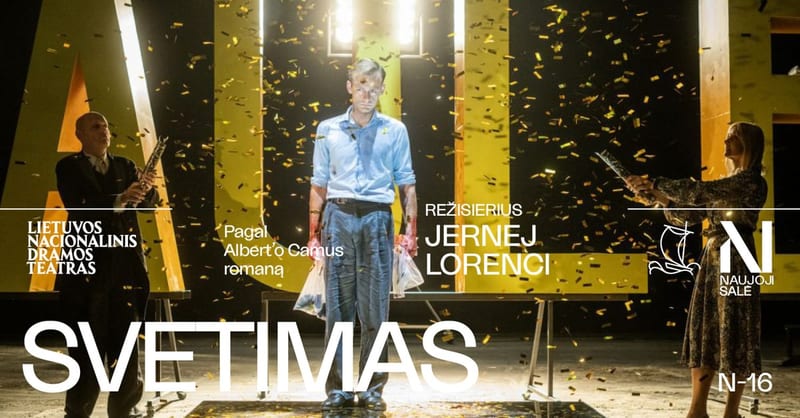
Based on the novel by Albert Camus. THE STRANGER, dir. Jernej LORENCI
THU, 03 DEC · 19:00
Lietuvos nacionalinis dramos teatras, Naujoji salė · Gedimino pr. 4
From €10Tickets ↓
About this event
Director, co-author of the adaptation — Jernej LORENCI
Dramaturg, co-author of the adaptation — Dino PEŠUT
Set designer — Branko HOJNIK
Composer — Gailė GRICIŪTĖ
Lighting designer — Julius KURŠYS
Choreographer — Gregor LUŠTEK
Costume designer — Belinda RADULOVIĆ
Translator of the adaptation text from Croatian — Laima MASYTĖ
Dramaturg's assistant, English translator — Eglė POŠKEVIČIŪTĖ
Director's assistant — Augustas GORNATKEVIČIUS
Set designer's assistant — Justas SABASTIJANSKAS
Producer — Agnė PULOKAITĖ
Producer — Lukrecija GUŽAUSKAITĖ
CAST
Diana ANEVIČIŪTĖ
Povilas BUDRYS
Dainius GAVENONIS
Algirdas GRADAUSKAS
Augustas GORNATKEVIČIU
Vaidilė JUOZAITYTĖ
Laurynas JURGELIS
Birutė MAR
Šarūnas Rapolas MELIEŠIUS
Aurelijus POCIUS
Augustė POCIŪTĖ
Irena SIKORSKYTĖ
Translated from French by Laima RAPŠYTĖ
The play "The Stranger," based on the book by Nobel Prize in Literature laureate Albert Camus, is directed by Slovenian director Jernej Lorenci, considered the most prominent figure in contemporary Slovenian theater, as well as one of the most individual, insightful, and innovative theater creators in Europe.
The novel "The Stranger," which explores themes of indifference, loneliness, and absurd coincidences, describes a short stage of the main character Meursault's life and his trial. Having refused to lie to himself and others, having disobeyed the rules imposed by society, and having fallen into a series of strange coincidences, Meursault is ultimately condemned not for a potential crime, but for being different – a stranger.
Is modern society, more tolerant than ever, actively defending human rights and standing up for the weak, truly tolerant of those who are different? Are there those who are different who are universally pitied, and others who are not? Where is the difference? How would you feel if you were in court trying to explain the motives for your behavior, only to receive the same biased questions and realize that your answers are actually of no interest to anyone? Would you fight or give up?
Director Jernej Lorenci states that Meursault is an iconic figure of twentieth-century literature and philosophy: "An outsider, a renegade, detached from everything and everyone. He observes the world from his shell. He has no position of his own. Does his 'detachment' have a philosophical meaning, or is it merely a way to endure? Is Meursault a weirdo or, after all, a visionary?
How would we describe him today, when we live in times of quick judgments and black-and-white truths? Now, when we are expected to have a clear opinion about everything, always firmly 'for' or 'against'? Either 'for' or 'against' – it has become like an all-encompassing commandment of God for us, a new catechism: for / against, either / or. We live in times when we are almost proud of our generalized and simplified opinion about everything. When we are furious, annoyed, so angry that it seems we are about to burst. When we cling to our truth with all our might, fighting for our exclusive right, that one, true one? We all wave our little flags of rights. A sea of flags, banners – that is what we are! And little by little, we are drowning in stupidity, which is increasingly threatening to turn into real blood."
In addition to numerous awards in Slovenia, Lorenci has also won many awards abroad: the New Theatrical Realities Prize (2017) and the Belgrade International Theatre Festival (BITEF) award (2013) are among the most important. In his work, the director rejects classical adaptation, and this play will be no exception. Camus' novel "The Stranger" will become the dramaturgical axis of the play, but during the creative process with the actors and the creative team, other relevant texts, contemporary contexts, and the creators' personal experiences will be used, all of which will turn into an original and relevant interpretation of the novel.
When & where
DEC
JAN