Translated from Swedish by Zita MAŽEIKAITĖ
Director — Jonas VAITKUS
Set Designer — Jonas ARČIKAUSKAS
Composer — Oleksandr ŠYMKO
Video Projection Designer — Algimantas MIKUTĖNAS
Choreographers – Vesta GRABŠTAITĖ, Jonas VAITKUS
Lighting Designer — Vilius VILUTIS
Assistant Set Designer — Dovilė GUDAČIAUSKAITĖ
Assistant Composer – Liudmyla ŠYMKO
Assistant Director — Regina GARUOLYTĖ
CAST
The Hunter — Vytautas RUMŠAS
The Woman — Rimantė VALIUKAITĖ
The Hermit — Remigijus BUČIUS
The Traveler — Eimantas PAKALKA
Miller of "Adam's" Mill; The Tempter — Šarūnas PUIDOKAS
Miller of "Eve's" Mill — Džiugas SIAURUSAITIS
Miller of "Eve's" Mill; The Teacher — Juozas ALIŠAUSKAS
Miller's Wife of "Adam's" Mill — Jūratė VILŪNAITĖ
Miller's Wife of "Eve's" Mill — Jurga KALVAITYTĖ
Young Woman; Girl — Alvydė PIKTURNAITĖ, Justė ZINKEVIČIŪTĖ
The Teacher — Arūnas SAKALAUSKAS
The Blacksmith — Vytautas ANUŽIS
Blacksmith's Wife - Ieva LABANAUSKAITĖ
The Organ Grinder — Gediminas SEDEREVIČIUS
Photographer — Mantas BARVIČIUS, Šarūnas Rapolas MELIEŠIUS
Euphrosyne; Voice of the Sacrificed Child — Dalia MICHELEVIČIŪTĖ
Gothard — Arūnas VOZBUTAS
Clara — Jolanta DAPKŪNAITĖ
Markata; The Japanese man's disowned daughter; Hand of the Eternal; Peasant girl — Birutė MAR
The Japanese man — Salvijus TREPULIS
Miller — Algirdas DAINAVIČIUS
Miller — Marius Michailas REPŠYS
People of the "Donkey" and "Liar" villages; Septet of the Temple singers — Juozas ALIŠAUSKAS, Diana ANEVIČIŪTĖ, Neringa BULOTAITĖ, Mantas BARVIČIUS, Vaidilė JUOZAITYTĖ, Jurga KALVAITYTĖ, Ieva LABANAUSKAITĖ, Aivaras MICIUS, Rasa RAPALYTĖ, Arūnas VOZBUTAS
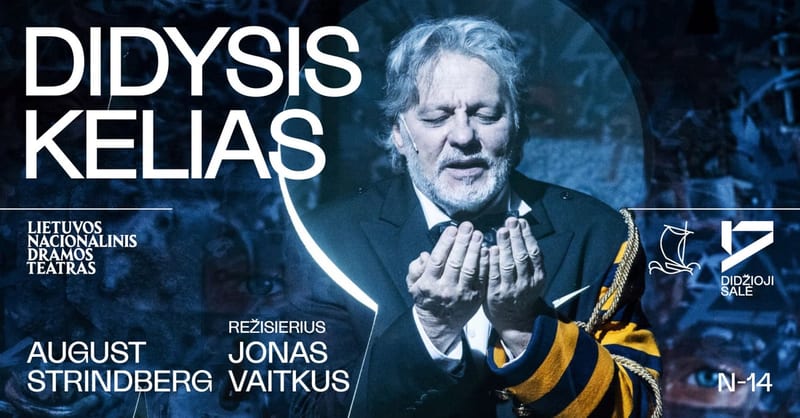
"The Great Highway" (Stora landsvägen) is August Strindberg's final play. The literal title of this drama refers to the street of Strindberg's own childhood, which led directly to the cemetery. It is no coincidence that his final drama is compared to a kind of testament or a theatrical self-portrait of the author. Strindberg depicts this drama as a journey into his own memory, where at every "stop" the drama's protagonist sees his own character and other allegorical figures of the narrative – the Traveler, the Child, the Tempter, or the Murderer. "The Great Highway" is an allegorical narrative, a summary of the playwright's life thoughts. Strindberg's contemporaries criticized him for combining everyday and poetic language, and for a lack of drama. "The Great Highway" stood out sharply from the rest of the playwright's work, yet this piece is valued by many of today's literary scholars as a compelling way to convey the fragile emotional and psychological state of a character without dramatization.
Director Jonas Vaitkus says: "This pre-death play by the playwright is a journey drama with seven stations. It is a reflection of his entire body of work – from concise, abrasive prose to contrasting leaps toward symbolism and metaphors with gender opposition and sexual deviations. Unrhythmic poetry that speaks about the inner emotional state of a thinking person, without dramatizing or overemphasizing the mortal fate, without fear of plunging into the stench of realism and naturalism and breaking out again with a satirical, ironic view of the unsolvable affairs of the Afterlife, Earth, and Man, without fear of admitting one's limitations. After all, you are condemned to death, and because of this, you experience daily sorrow and suffering in the face of divine eternity. But you do not consider it a punishment or total evil against which you must rebel or throw yourself into disastrous atheistic or other extremes, although there were and are many who perished themselves and destroyed millions. You simply accept it as the tragedy of an unchangeable, inevitable given, as a mandatory tax for the grace granted to exist, for the priceless gift of eternity granted to be a consciously acting human being in this tragedy, which protects, heals, and clarifies the soul.
I am not surprised why this play is unknown in Lithuania and untranslated in Russia. It is very rarely staged even in August Strindberg's homeland.
"The Great Highway" unscrupulously strips man as such, a person from any land, any nationality, gender, color, or anything else. A person vulnerable in the face of eternity.
August Strindberg comes to the troupe of the Lithuanian National Drama Theatre at the right time and at the right time to the Lithuanian people, who are preparing to build a welfare state."
Swedish writer and playwright August Strindberg (1849–1912) is one of the most important theater figures in the world. He is called the pioneer of modern theater. He is a playwright who was ahead of his era, expressing in his work all the literary movements and schools of his time. He is considered a naturalist, a neo-romantic, and a pioneer of expressionism and surrealism in literature.
Strindberg not only wrote dramas, he also loved to experiment as a photographer and painter; his works are attributed to abstract expressionism. Although Strindberg is now well-known not only in Sweden but all over the world, his work did not immediately receive sufficient attention; he was even ignored by Swedish society and accused of using sexual motives in his works to attract readers.