Exhibition
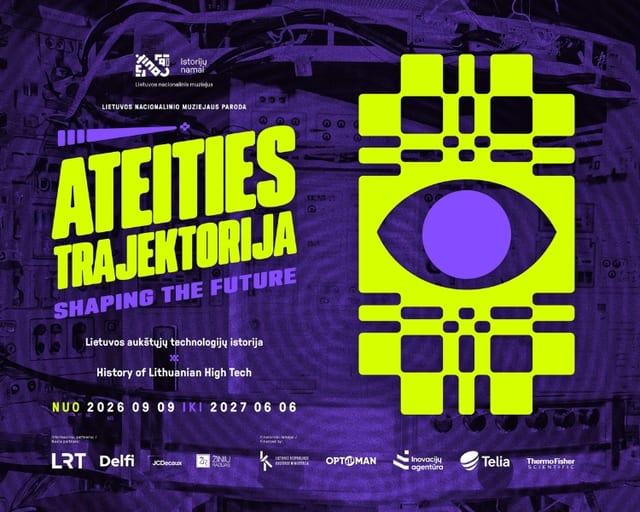
Trajectory of the Future. A History of Lithuanian High Technologies
About this event
Technology is an inseparable part of everyday life. It fits in our pockets, helps diagnose diseases, transmits messages, stores data, explores space, and changes how we learn, work, heal, or communicate. It is so common that we rarely ask how it all began.
And it did not begin with a device, a microchip, or a laboratory process. It began with a person. With a question that someone would not let go of. With a mistake that opened a new path. With long, often invisible work. With curiosity, persistence, and belief in an idea that, at the time, might have seemed too bold, too distant, or even impossible.
In "Trajectory of the Future," technology becomes part of cultural history – a narrative about why it emerged, who created it, and what it says about society, the state, the era, and human imagination. At the same time, it is an opportunity to see Lithuania not just as a country that uses global progress, but as a country that creates it.
Lithuania's technological trajectory did not begin yesterday and does not end with today's startups. It stretches from the knowledge, measurement, calculation, engineering thought, and patronage traditions of the Grand Duchy of Lithuania to modern lasers, biotechnologies, space technologies, robotics, information technologies, and the unicorn ecosystem. This trajectory did not always fit within Lithuania's geography – some scientists of Lithuanian descent continued it in the West, leaving behind stories that we are only just beginning to tell in Lithuania.
This path was shaped by scientific schools, laboratories, institutes, communities, coincidences, bold decisions, and people who worked quietly. However, telling this story is not simple: its traces have long been scattered across company archives, private drawers, documents, prototypes, and human memory.
Therefore, the exhibition brings people back into the history of Lithuanian high technologies – scientists, engineers, programmers, and inventors. Their stories have been told too little until now, because some of the creators worked in times when it was not customary to talk about oneself, and the world of technology had not yet created prominent public heroes.
Also important here is the less frequently told side of progress – those who believe in ideas before others do. Historical founders, patrons, entrepreneurs, modern foundations, and representatives of the high-tech sector remind us that the boldest discoveries are not born in a vacuum: they need an environment, trust, and support even when no one can guarantee the result.
Technology is not just a sign of the present – it has its own past, creators, and place in Lithuanian cultural history. And the future always begins long before it becomes visible.


