VILNIUS·KAUNAS
LT·EN
Scena
Scena
  • Discover
  • Films
  • Theater
  • Events
City
VILNIUS·KAUNAS
Language
LT·EN
  • Discover
  • Films
  • Theater
  • Events
Scena

Films, stages, concerts and nights out across the city — gathered into one live programme, updated daily.

Browse

  • What's on
  • Discover
  • Films
  • Theater
  • Events
  • Venues

© 2026 Scena · Where the City Happens

  • Search events, venues, dates, or what to do next.
↑↓navigate↵openescclose
  • Discover
  • Films
  • Theater
  • Events
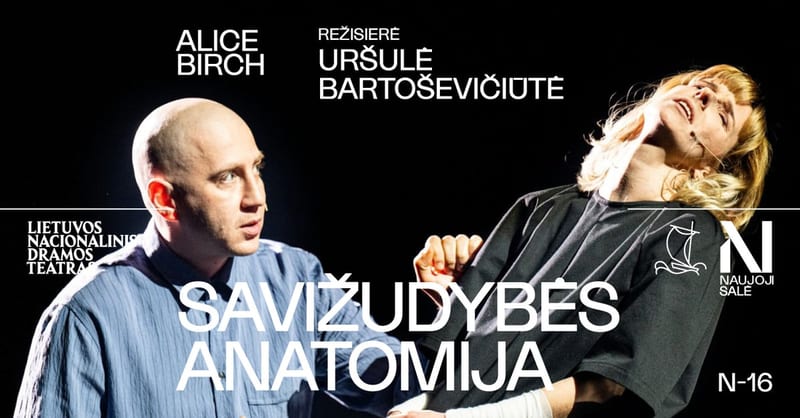
Alice Birch. ANATOMY OF A SUICIDE, dir. Uršulė BARTOŠEVIČIŪTĖ
Theater

Alice Birch. ANATOMY OF A SUICIDE, dir. Uršulė BARTOŠEVIČIŪTĖ

WED, 14 OCT · 19:00
Lietuvos nacionalinis dramos teatras, Naujoji salė · Gedimino pr. 4
Tickets ↓
Details
Organizer
Lietuvos nacionalinis dramos teatras

About this event

Director — Uršulė BARTOŠEVIČIŪTĖ

Set and Lighting Designer — Agata SKWARCZYŃSKA

Costume Designer — Liucija KVAŠYTĖ

Composer — Ieva PARNARAUSKAITĖ

Choreographer — Oksana GRIAZNOVA

Assistant Directors — Deivydas VALENTA, Gustas RUPŠYS

Assistant Costume Designer — Izidorius LIAUČIUS

Producer — Kamilė ŽIČKYTĖ

CAST

Carol — Augustė POCIŪTĖ

Anna — Augustė Ona ŠIMULYNAITĖ

Bonnie — Žygimantė JAKŠTAITĖ

John (Carol's husband) — Marius Michailas REPŠYS

Jacob (documentarian) — Kęstutis CICĖNAS

Jo; Nurse; Lola (Carol's school friend) — Dovilė KUNDROTAITĖ

Dr. Dan; Real Estate Agent; Doctor; Patient's son — Vytautas ANUŽIS

Ruth as a child; Anna as a child; Neighbor's child; Tim's daughter; Child — Aistė ROCEVIČIŪTĖ

Emma (John's sister); Real Estate Agent; Ruth (adult); Bonnie's lover; Nurse; Doctor; Woman — Jūratė VILŪNAITĖ

Tim (Bonnie's colleague); Tadas (Emma's husband); Doctor (psychotherapist) — Algirdas GRADAUSKAS

Translated from English by Rita KOSMAUSKIENĖ

The play "Anatomy of a Suicide" intertwines the stories of three generations of women in one family: it analyzes the lives and fates of a grandmother, daughter, and granddaughter, capturing pivotal, textbook, unique, and entirely mundane stages and events in a woman's life. It explores themes related to the formation of family and romantic friendships, the mechanisms of generational patterns and relationships, loss, societal expectations imposed on women, the anatomy of the act of suicide, and the analysis of sin: from its commission, repentance, mourning, and blame to forgiveness.

"Ever since I learned that a woman is born with all the eggs that form while she is still in the womb, I began to perceive the question of generations much more physically. Today, it is becoming very relevant to me – our grandmothers' experiences live genetically within us; the historical traumas they lived through and their responses to them are alive. Then I wonder: what scars will my generation have, what political and historical marks will be encoded in the children who will live a hundred years from now?" reflects director Uršulė Bartoševičiūtė, who is presenting her first play at the Lithuanian National Drama Theatre.

When & where

OCT
NOV
WED · OCT
1419:00

Lietuvos nacionalinis dramos teatras, Naujoji salė

Tickets ↗
© OpenStreetMap, CARTO
VenueLietuvos nacionalinis dramos teatras, Mažoji salė

Gedimino pr. 4

What's on at this venue →

Carol is a woman living in a traditional marriage who, after falling into clinical depression, makes the decision to commit suicide. Her daughter Anna, trying to escape her parents' relationship and life patterns, retreats to a commune, where she reconsiders the principles of communal living and sinks into drug addiction. After giving birth to her daughter Bonnie, Anna soon also chooses suicide. Bonnie, in turn, tries to end the transgenerational trauma of suicide and break the chain of such choices. She becomes a doctor and, unlike her mother, chooses a rational way to systematize and understand the burden of her family history – she seeks medical and scientific answers. She decides to sell the family home and get sterilized. Although she is a lesbian and cannot biologically have children with her partner, it is important to Bonnie to prevent any possibility that she will continue this lineage and pass on to her descendants what she herself received from her mother and grandmother.

In the play, Carol, Anna, and Bonnie are portrayed at a similar age – they are all young women in their thirties, and their stories are told to the audience simultaneously. Different timelines allow the audience to view the life of one family not as a random combination of actions and reactions, but as a transgenerational chain of events.

The play's author, British playwright and screenwriter Alice Birch, looks at suicide, as the title suggests, anatomically, i.e., she does not judge, evaluate, or justify the women's actions, aiming for a certain objectivity in the narrative. The author, stating that she wrote the work more as a score than a play, allows the creative team and the audience to look at the plot through the eyes of a detective – to notice and record the non-obvious symbols, signs, and traces that accompany this family, and thus discover what each of us repeats without thinking, inherits from our parents, and carries from generation to generation.

Alice Birch's work is often compared to the plays of the scandalous British playwright Sarah Kane – they are linked by a similar relationship with modern existentialism, the depiction of people often left on the margins, the analysis of marginal and extreme personal experiences – self-destruction, the ineffectiveness of institutions (especially relationships with medical staff) – and the portrait of an exhausted, surrendering woman. The image of a woman leaving her final words as a testament.

Partner: