Music
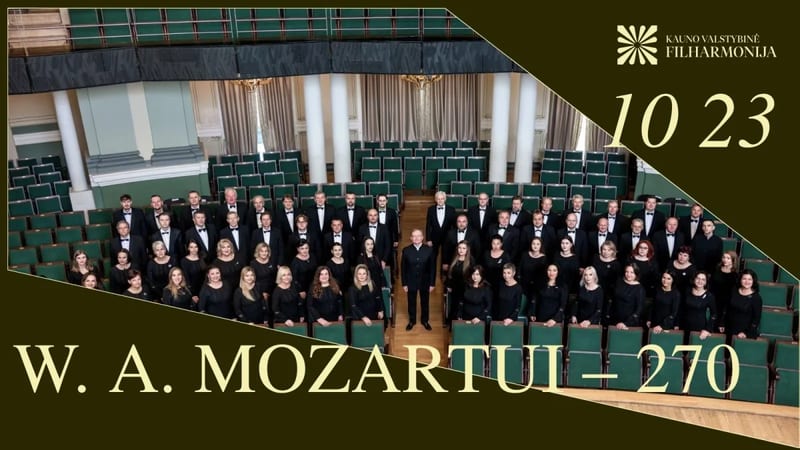
W. A. mozart – 270
About this event
Performers: Kaunas city symphony orchestra Chief Conductor Constantine Orbelian (USA), Manager Algimantas Treikauskas Kaunas state choir Artistic Director and Chief Conductor Robertas Šervenikas
Soloists: GINTARĖ RAMANAUSKAITĖ (soprano) VILIJA MIKŠTAITĖ (mezzo-soprano) MINDAUGAS ZIMKUS (tenor)
POVILAS STRIKAITIS (bass)
ALEXANDER PALEY (piano, USA–France–Lithuania)
Conductor ROBERTAS ŠERVENIKAS
Program:
Wolfgang amadeus mozart:
Part I
Piano Concerto No. 20 in D minor, K. 466
Part II
Requiem in D minor, K. 626
Commemorating the 270th anniversary of Wolfgang Amadeus Mozart's birth, his immortal work "Requiem" will be performed at the Kaunas State Philharmonic. This masterpiece is special not only for its sonic power, depth, and sensitivity but also for the mysterious history of its creation, which was interrupted by the composer's untimely death.
"Requiem," a mass for the dead, is one of W. A. Mozart's most famous compositions, written by the composer in 1791 but left unfinished. It was the composer's final work, scored for 4 soloists, mixed choir, and orchestra, and completed after W. A. Mozart's death by his student Franz Xaver Süßmayr.
W. A. Mozart wrote relatively little church music. According to legend, a stranger dressed in black visited him and commissioned the composer to write a funeral mass. About this visit, a couple of months before his death, the composer wrote in a letter: "I cannot forget this stranger; he stands before my eyes – begging, pursuing, demanding. I continue, because work tires me less than rest. My intuition whispers that my hour has come; I am going to my death; I will meet it before I could have enjoyed my talent. Life is so beautiful, it was so promising, but what is destined cannot be changed. No one knows how many days are left; one must surrender to fate. I finish, because the funeral song awaits me, which I must complete."
"Requiem" consists of 12 parts. Especially memorable are the parts "Dies irae" ("Day of Wrath") and "Lacrimosa" ("Weeping"). "Dies irae" is particularly dramatic and active, depicting the terror of death and people's pleas for mercy. "Lacrimosa" is an oasis of peace, characterized by subtle lyricism, restrained lamentations, and painful sighs between the words.