Music
(Un)serious music evening
About this event
In the Small Hall
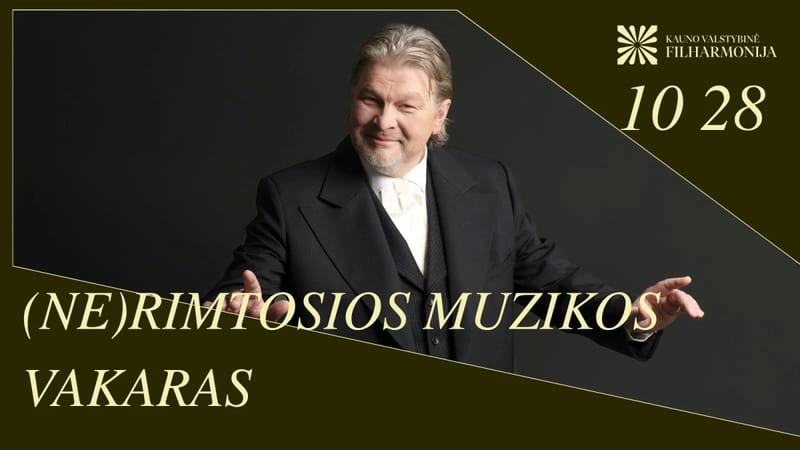
Performers: GIEDRIUS PRUNSKUS (baritone) EGLĖ KIŽYTĖ-RAMONIENĖ (piano)
Program: ANATOLIJUS ŠENDEROVAS – vocal cycle "The Cow Ate the Hay" (text by Sigitas Geda): "The Cow", "The Cat's Thinking", "If", "The White Owl", "It Would Be Good", "Sad Landscape", "Maybe", "Why", "In the Evenings" ARNOLD SCHÖNBERG – "Brettl-lieder" ("Cabaret Songs"): "Galathea", lyrics by Frank Wedekind "Gigerlette", lyrics by Otto Julius Bierbaum "Der genügsame Liebhaber" ("The Modest Lover"), lyrics by Hugo Salus "Mahnung" ("Warning"), lyrics by Gustav Hochstetter "Einfaltiges Lied" ("Simple Song"), lyrics by Hugo Salus "Jedem das seine" ("To Each His Own"), lyrics by Colly "Nachtwandler" ("Night Wanderer"), lyrics by Gustav Falke "Arie aus dem Spiegel von Arcadien" ("Aria from 'The Mirror of Arcadia'"), lyrics by Emanuel Schikaneder BERND ALOIS ZIMMERMANN – "Extemporale" for solo piano FELIKSAS BAJORAS – "Suite of Sagas" (texts based on Lithuanian folk): Prelude Part I "Animals and People": "The Mole", "The Crayfish", "The Skylark and the Swallow" Part II "Trees and People": "Why Trees No Longer Speak", "The Blind Ash", "Oh Oak Tree" Part III "Devils and People": "Devil's Pranks", "The Fearless Shoemaker", "Devils Need Girls" Postlude VYTAUTAS BARKAUSKAS – "Wishes" from the vocal cycle "Three Satirical Pictures" (text by Algimantas Pabijūnas)
We are accustomed, or perhaps taught, to look at many things seriously and responsibly. With furrowed brows and narrowed eyes. But if you allow yourself to look at one problem or another less seriously, you will certainly get a chance to solve that problem. Perhaps from an unexpected angle or in a way not acceptable to everyone, but the problem will definitely disappear. Two musicians, united by their love for the art song genre, pianist Eglė Kižytė and baritone Giedrius Prunskus, invite you to look at the works of composers considered very serious from a slightly different angle.
How did it happen that Feliksas Bajoras, considered a guru of Lithuanian academic music, perfectly expressed his relationship with national Lithuanian creativity by using a not-entirely-serious genre – sagas? What prompted Arnold Schönberg, who shocked the world with his dodecaphonic works, to compose songs intended for a completely unserious stage – the Vienna cabaret? Why did Anatolijus Šenderovas, whose scores are sometimes difficult even for serious orchestras to grasp, take on the children's poems of Sigitas Geda, in which natural life situations are hidden behind a mask of "unseriousness"? Why is the work of Bernd Zimmermann, who created one of the most significant German operas of the 20th century, always meticulously written down, yet sounds free, as if it were an improvisation born here and now? By diving in all seriousness into the context of the "(Un)serious Music Evening" program, you will certainly find the answers to these and other "serious" questions, because the performers of the evening are truly in an (un)serious mood.