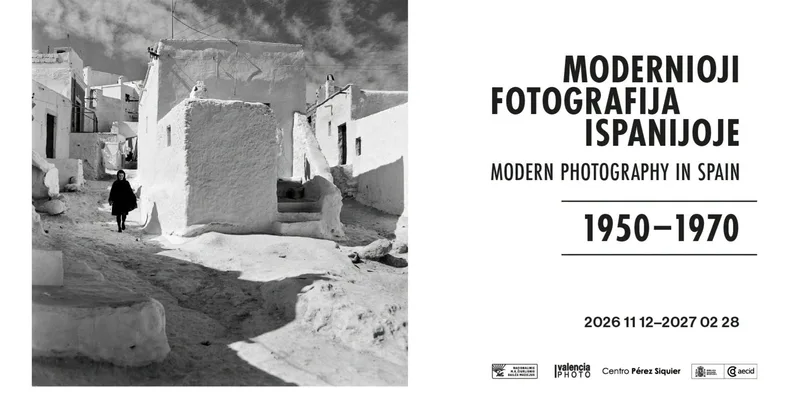
“Modern Photography in Spain 1950–1970”
About this event
On Thursday, November 12, at 5:30 PM, the opening of the exhibition “Modern Photography in Spain 1950–1970” will take place at the National M. K. Čiurlionis Art Museum (V. Putvinskio St. 55, Kaunas). It will be graced by the dance performance “DUELE” by flamenco dancer Elena Tello Dobilaitė, choreographed by Patricia Carión Costa. The dancer will perform in a costume created specifically for this occasion by flamenco fashion designer Rima Pocevičienė. The 1950s and 1960s were a decisive period for the artistic modernization of Spain. Against the backdrop of the consequences of the Civil War, cultural isolation, and the Franco dictatorship, a new generation of photographers began to seek alternative forms of expression, aiming to establish the autonomy of photography as an independent art form and to create new relationships between image and reality. “Art, and in this case photography, not only reflects the reality of its time but also questions it, offering new ways of understanding it. Artistic creation testifies to the vitality of a society, its contradictions, and its pursuit of freedom. Therefore, it is particularly meaningful to present this exhibition at the National M. K. Čiurlionis Art Museum. Through his work, Čiurlionis contributed to the establishment of Lithuanian identity at a time when Lithuania was ruled by the Russian Empire. Similarly, although under different historical circumstances, Spanish photographers during the Franco dictatorship questioned established norms and expanded spaces for expression and freedom. This exhibition establishes a dialogue between two cultural experiences in which art became an expression of identity, critical thinking, and the pursuit of freedom,” says exhibition curator Nicolás Llorens Lebeau. The exhibition presents some of the most important representatives of this transformation, including five winners of the Spanish National Photography Award: Gabriel Cualladó, Joan Colom, Carlos Pérez Siquier, Ramón Masats, and Alberto Schommer, as well as other prominent artists such as Francesc Català-Roca, Xavier Miserachs, Oriol Maspons, Ricard Terré, Francisco Gómez, Nicolás Muller, José María Artero, Francisco Ontañón, and Jesús de Perceval. In the first half of the 20th century, Spanish photography still showed clear traces of the pictorialism that had prevailed at the end of the 19th century. Its proponents sought artistic recognition by bringing photography closer to painting or graphic arts. Late pictorialism, associated with the aesthetics of regionalism and the exaltation of traditions, popular character types, and national landscapes, found a favorable environment during the Franco regime. However, in opposition to this tradition, a new generation of photographers emerged in the 1950s and 1960s, bringing significant changes to Spanish photographic art. These artists abandoned the principles of idealized representation, directing their documentary and humanistic approach toward the everyday life of people, the urban environment, and social changes. An important role in the development of Spanish photography was played by the magazine AFAL, founded in Almería in 1956, which brought together photographers from all over Spain, encouraged the exchange of ideas, and established connections with international photography movements. The publication of the Spanish photography yearbook (Anuario de la fotografía española) in 1958 strengthened the visibility of this community. Despite different artistic approaches, the photographers were united by the desire to depict not the country idealized by the official propaganda of the Franco regime, but a reality marked by social inequality, urban transformation, and the tension between tradition and modernity. Their work became an important foundation for contemporary Spanish photography and helped it establish itself in the context of international artistic modernism. On November 13, at 4:30 PM, a lecture by the curator of the exhibition “Modern Photography in Spain 1950–1970,” Nicolás Llorens Lebeau, will take place. The lecturer will review the changes in Spanish photography of the 1950s and 1960s in the context of the European artistic avant-garde and will draw attention to the influence of the Francoist regime on the historical and cultural development of the country. The lecture will analyze the work of the Spanish photographic avant-garde of the 1920s and 1930s, which was strongly influenced by the Civil War and the subsequent dictatorship, and will also present the new generation of photographers that emerged in the 1950s, whose refined visual means of expression fundamentally dismantled the principles of pictorialism and academicism. The lecture will also discuss the connection between the renewed photography and other art movements of the same period, especially Spanish informalism, with the lecturer emphasizing the importance of aesthetic experiments in forming a critical view of the society of that time. The lecture will be held in Spanish with translation into Lithuanian. Participation in the lecture is free.
Exhibition curator: Nicolás Llorens Lebeau Exhibition organization: Vilma Dobilaitė Exhibition designer: Lina Mozūraitė Exhibition coordinator: Gintarė Žaltauskaitė-Mikutavičienė Organizers: National M. K. Čiurlionis Art Museum, ValenciaPhoto Partners: Centro Pérez Siquier, Embassy of Spain Exhibition dates: 2026 11 12 – 2027 02 28 The exhibition opening event is free; on other days, admission is with a museum visitor ticket.
The event is public and may be filmed and photographed. By participating in the event, you agree to be visible in event photos and videos and are informed that these photos and videos may be published publicly.