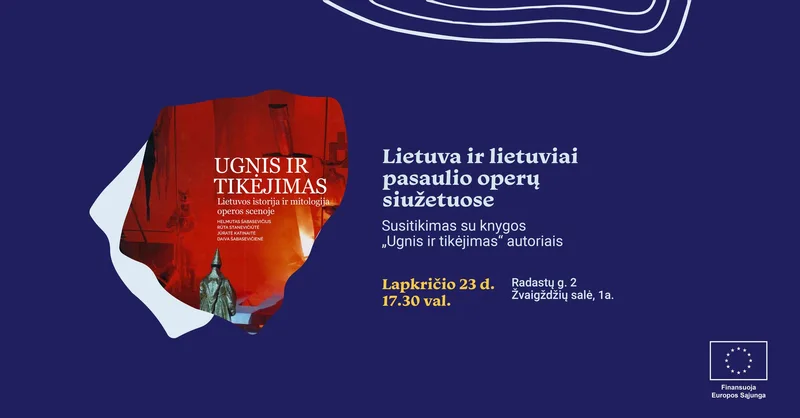
Lithuania and Lithuanians in world opera plots: a meeting with the authors of the book "Ugnis ir tikėjimas"
About this event
If in the Lithuanian cultural consciousness, national opera plots are associated with a dozen operas created in Vilnius and Kaunas in the 20th–21st centuries, it is time to look broader – the authors of the monograph "Ugnis ir tikėjimas. Lietuvos istorija ir mitologija operos scenoje" (2025) have discovered Lithuanian themes in 67 operas created from the beginning of the 18th century to the present day, not only in Lithuania but also in Italy (not just Amilcare Ponchielli's "I Lituani"), Poland, Russia, Belarus, Germany, France, the USA, and Australia. We invite you to get acquainted with Lithuania and Lithuanians in opera plots on November 23 at 5:30 PM in the Žvaigždžių salė (Radastų St. 2, 1st floor) – a presentation of the monograph and a musical program await, performed by singer Ugnė Stražnickaitė, who debuted at the Pažaislis Music Festival this summer, and pianist Audronė Eitmanavičiūtė. About the monograph In this collective monograph, Helmutas Šabasevičius, Rūta Stanevičiūtė, Jūratė Katinaitė, and Daiva Šabasevičienė examine the development of Lithuanian-themed opera from an interdisciplinary perspective, ranging from the opera-oratorio "San Casimiro, rè di Polonia" (1704–1705?) commissioned by Queen Maria Casimira of the Polish-Lithuanian Commonwealth to Constantine Koukias's opera "Olegas" (2007), staged at the Hobart experimental theater in Tasmania. Against the backdrop of cultural and political transformations, the text discusses in greater detail operas staged in the 19th–21st centuries in Lithuanian and Polish theaters, the State Theater, the Lithuanian National Opera and Ballet Theatre, the Kaunas and Klaipėda State Musical Theaters, and the Chicago Lithuanian Opera. The publication also provides summaries of operas created and staged on themes of Lithuanian history and mythology. Details regarding the creation, staging, and reception of these Lithuanian-themed operas reveal an intriguing and non-generalizable diversity of interpretations in national and foreign musical theaters. The monograph is named after the opera-ballet "Ugnis ir tikėjimas" (2003) by Bronius Kutavičius, known as the magician of Lithuanian music (the original Latin title is "Ignis et fides"). The work, created together with religious scholar and ethnologist Gintaras Beresnevičius, is permeated by the most important leitmotif of Lithuanian historical operas – the eternal struggle for the right to live in one's own land with one's own values. The book is written for readers interested in language, history, and culture. The work was edited by Paulius Garbačiauskas, designed by Liudas Parulskis, and published by the Lithuanian Academy of Music and Theatre and the Vilnius Academy of Arts Press. The event is part of the "Conversations about Music" cycle and is organized as part of the international Erasmus+ project "The Lyrical Seed" (LySeed, No. 2024-2-ES01-KA210-VET-000285569), which aims to strengthen the competencies of young performing arts professionals, promote international cooperation, and increase the accessibility of musical theater to diverse audiences. Funded by the European Union. The views and opinions expressed are those of the author(s) only and do not necessarily reflect those of the European Union or the Spanish Service for the Internationalization of Education (SEPIE). Neither the European Union nor the granting authority can be held responsible for them. The event will be photographed and/or filmed, so you may be visible in event photos or videos that may be published in various media outlets.