Workshop
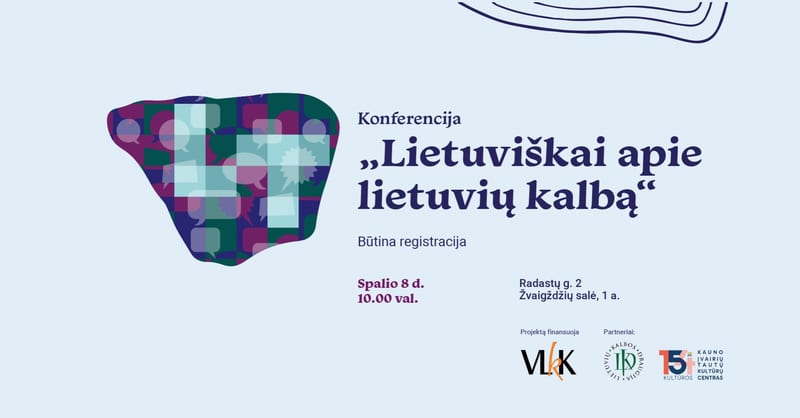
Conference "In Lithuanian about the Lithuanian language"
About this event
On October 8, the Ąžuolynas Library will host the conference "In Lithuanian about the Lithuanian language," inviting us to view the Lithuanian language as a promising and significant language that is being discovered by more and more foreigners who have arrived in Lithuania. The conference is relevant to library and cultural institution staff, language researchers, students, Lithuanian language teachers working with foreigners, foreigners who have learned some Lithuanian, and anyone interested in the Lithuanian language and its future. We invite you to participate! Location: Žvaigždžių Hall (Radastų St. 2, 1st floor) Seating at the event is limited; registration is required. The conference will discuss how foreigners learn the Lithuanian language, what motivates them to learn it, what challenges they face, and how their relationship with Lithuania and its culture changes once they start speaking Lithuanian. Scientific insights will be complemented by the practical experiences of teachers and learners. "When talking about the Lithuanian language, we often think first about its preservation, its correctness, and why our compatriots do or do not speak it. However, the Lithuanian language has long been no stranger to people who come to Lithuania from other countries to study, work, or live. Their experiences allow us to look at our language from the outside and better understand what it is like for a person who has not learned it since childhood," state the conference organizers. This conference aims to establish a dialogue about the language and our relationship with it, without limiting it to the experience of native speakers alone. The Lithuanian language is becoming an important part of daily life even for those who chose to learn it as adults. Their stories and experiences can help not only to better understand the language learning process but also to take a fresh look at the Lithuanian language itself. Program
09:30–10:00 Registration of conference participants 10:00–10:10 Opening 10:10–11:10 Is the Lithuanian language really that difficult? Dr. Jogilė Teresa Ramonaitė (Institute of the Lithuanian Language) The presentation introduces a study on the acquisition of Lithuanian as a second language, revealing how this natural process occurs not chaotically, but in a certain sequence. It reviews how, starting with completely elementary yet communicatively effective ways of expression, an increasingly complex system resembling the target language is gradually constructed. 11:10–11:40 I am learning, but am I learning it? Viktorija Ivanova (viktorija.kalba) What challenges and fears do Lithuanian language learners face? How to teach/learn sustainably so that knowledge and skills remain? Why is the Lithuanian language even needed at all? 11:40–12:40 Lunch break 12:40–13:10 The Lithuanian language – a treasure to be protected Stefano M. Lanza (Vytautas Magnus University) The presentation will discuss what makes the Lithuanian language unique and valuable, and why it is important to protect it. Questions will also be raised about our own responsibility to nurture, cherish, and pass it on to future generations. 13:10–13:40 The Lithuanian language through the eyes of an immigrant: what do teachers not see? Ekaterina Tumashik (LABASklabas) The presentation will share her own and other foreigners' experiences: what helps one start speaking, what difficulties arise in daily life, and why we are sometimes more afraid to speak than to learn grammar. 13:40–14:10 Coffee break 14:10–15:40 Discussion "Is it still worth speaking Lithuanian?" Participants: Dr. Jogilė Teresa Ramonaitė, Viktorija Ivanova, Stefano M. Lanza, Ekaterina Tumashik. Moderated by Dr. Monika Stankienė. The discussion will raise questions about the current situation of the Lithuanian language, multilingualism, reasons for language use, identity, and experiences in learning it. 15:40–15:45 Questions, summary. About the conference participants