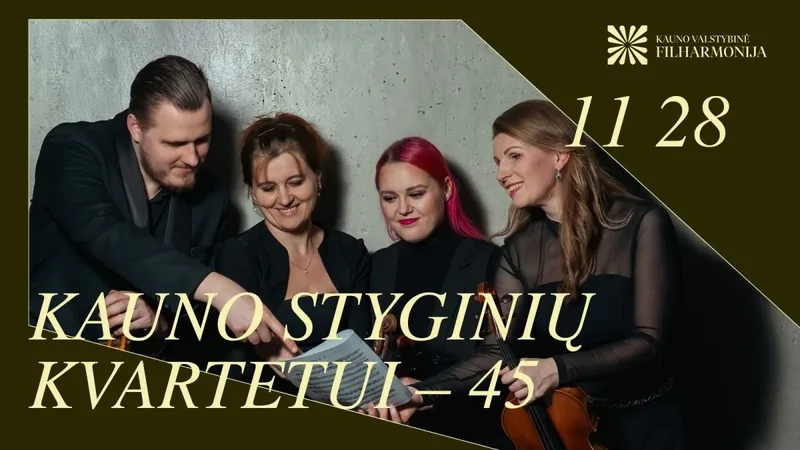
Kaunas string quartet – 45
About this event
Performers:
Kaunas string quartet
Karolina Beinarytė-Palekauskienė (artistic director, first violin)
Aistė Mikutytė (second violin)
Eglė Lapinskė (viola)
Kasparas Šerpytis (cello)
MINDAUGAS ZIMKUS (tenor)
GUODA GEDVILAITĖ-GÖHLE (piano)
Concert host: ŠVIESĖ ČEPLIAUSKAITĖ
Program:
JULIUS JUZELIŪNAS – String Quartet No. 1
GIEDRIUS KUPREVIČIUS – "Songs of a One-Day Homeland" for tenor and string quartet KASPARAS ŠERPYTIS – Miniature for string quartet (premiere)
CÉSAR FRANCK – Piano Quintet in F minor, Op. 14
A moment before the first note. An intake of breath, a nod, and wonderful music floods the space. This is how the Kaunas String Quartet, celebrating its 45th anniversary this year, tells its story.
"Making music is a kind of acting. We have to step out of our comfort zones to dare to 'get into character.' Not everyone succeeds at first, but gradually we gain courage, and then we enjoy it ourselves. While playing in the quartet, we have had to shout, whistle, sing, and play non-traditional instruments. We haven't had to dance yet, but that's probably only for now. So, when you come to a string quartet concert, you can expect various surprises," smiles artistic director Karolina Beinarytė-Palekauskienė, who has been playing first violin in the quartet since 2003.
Today, three other musicians are creating the quartet's history together with Karolina. Aistė Mikutytė, who plays second violin, joined the ensemble in 2016, violist Eglė Lapinskė in 2010, and cellist Kasparas Šerpytis has been playing with them for a little over three years.
The different characters and musical tastes of the quartet members are also revealed in their chosen concert program, where you will be able to hear everything from a playful musical miniature for string quartet created specifically for the anniversary concert to César Franck's Piano Quintet in F minor, a work with a very intriguing history.
It is said that César, at the age of 56, fell in love with his young student and, inspired by her, wrote this piece, but Camille [Camille Saint-Saëns], to whom this work was dedicated and who performed the piano part himself at the premiere in 1880, demonstratively left the score on the stage after the performance and refused to accept the dedication. And one cannot understand why—perhaps he was courting the same student himself, or perhaps he really did not like the piece, or maybe he was simply jealous of the success of the work so masterfully composed by Franck... But you could only find out the real reason by coming to the concert.