Music
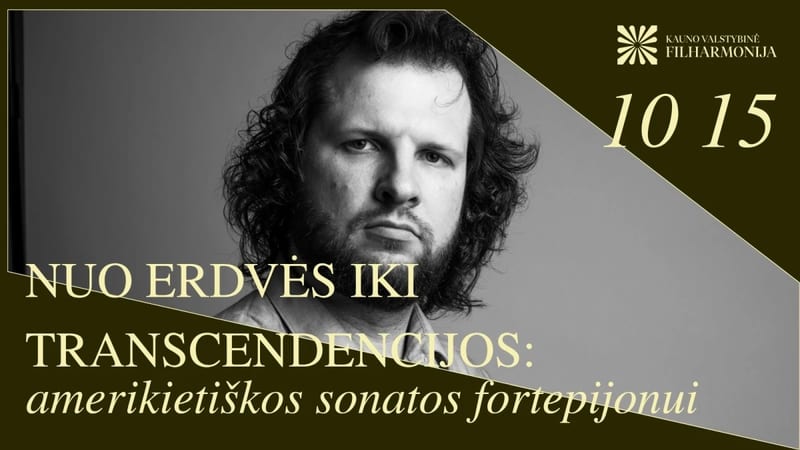
From space to transcendence: american piano sonatas
About this event
Performer
MOTIEJUS BAZARAS (piano)
Program:
Part I
AARON COPLAND – Piano Sonata
SAMUEL BARBER – Piano Sonata in E-flat minor, Op. 26
Part II
CHARLES IVES – Piano Sonata No. 2, "Concord, Mass., 1840–1860"
I. "Emerson" (after Ralph Waldo Emerson)
II. "Hawthorne" (after Nathaniel Hawthorne)
III. "The Alcotts" (after Bronson Alcott and Louisa May Alcott)
IV. "Thoreau" (after Henry David Thoreau)
This program, performed by the versatile and multifaceted young-generation pianist Motiejus Bazaras, is like a journey: from the space created by Aaron Copland, through the emotional and virtuosic culmination of Samuel Barber, to the musical and philosophical transcendence of Charles Ives. These are three different answers to the question of what American music is.
20th-century American music is often perceived as searching for its identity between European tradition and a new, distinct voice. This program brings together three piano sonatas that reveal different paths of this search.
A. Copland's Piano Sonata is an example of transparent structure and refined sound. One can feel space and openness in his music, as if it were a vast American horizon. A. Copland creates a language that consciously moves away from European complexity and strives for simplicity, yet maintains internal tension and discipline.
S. Barber's Sonata in E-flat minor, Op. 26, is the opposite pole. It is an intense, dramatic, virtuosic work in which the spirit of the European tradition is still alive. The final fugue is particularly impressive – one of the most technically demanding episodes in the 20th-century piano repertoire. S. Barber combines everything into romantic expression with modern language, creating emotional yet structurally rigorous music.
Ch. Ives's "Concord Sonata," which will be performed in the second part of the concert, is one of the most unique piano works in music history. It is not just music, but also a philosophical reflection inspired by the transcendentalists – Ralph Waldo Emerson, Nathaniel Hawthorne, Bronson and Louisa May Alcott, and Henry David Thoreau.